

Navigating creation, orchestration, and dynamic distribution for media publishers
The landscape unveiled at Google I/O 2026 signals a fundamental shift in the media and entertainment industry: we have officially graduated from the era of static, pre-produced digital content to the Agentic Media Era. For executive leaders, programming directors, and operations chiefs at mid-market media houses and digital publishing networks, this evolution is far more disruptive than previous format transitions.
The industry is moving rapidly away from passive video files, static articles, and linear streaming channels. Autonomous background-running production agents, real-time media synthesis, unified multimodal asset pipelines, and screenless, context-aware ambient distribution define the new reality.
As global digital operations scale to process over 3.2 quadrillion tokens monthly, AI has transitioned from an external optimization tool to an ambient, real-time operating layer. This technological velocity is mirrored in enterprise economics; recent research from McKinsey & Company indicates that generative AI is poised to unlock up to $340 billion in value across the global media and entertainment sector, primarily by condensing production lifecycles and hyper-personalizing output.
For mid-market media organizations—which must compete with both Hollywood-scale budgets and hyper-nimble independent creators—leveraging this shift is critical for operational survival. This analysis details the structural impacts of the Agentic Era on media production, distribution, and consumption, outlining the precise technical and strategic pivots required to secure audience share and monetize intellectual property.
The revolution in media production and creative workflows
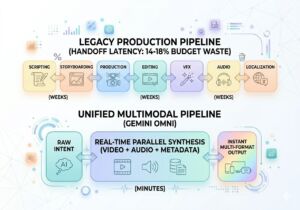
Historically, mid-market media production has been constrained by linear timelines and heavy operational overhead. Workflows for scriptwriting, storyboarding, filming, rough cuts, visual effects, sound design, color grading, and localization have traditionally run in sequence, with each handoff introducing friction, delay, and cost.
According to a study on content supply chains by the Everest Group, operational inefficiencies and manual handoffs in legacy media workflows cost mid-market firms an average of 14% to 18% of their annual production budgets. The introduction of unified, native multimodal architectures—spearheaded by platforms like Gemini Omni—dismantles these traditional pipelines by transforming sequential stages into concurrent, real-time workflows.
1. Unified real-time asset synthesis
Until recently, generative AI in media production operated via highly fragmented pipelines, requiring creators to jump between separate text, image, and voice models. This created massive latency, mismatched styling, and a complete lack of continuity.
The launch of unified neural networks like Gemini Omni Flash changes the economics of media generation. By processing and generating high-fidelity video, multi-layered audio, and vector-like graphics simultaneously within a single network, creative workflows can occur in real time. Boston Consulting Group (BCG) reports that over 72% of media executives cite “creative consistency across formats” as their primary operational barrier when scaling multi-platform campaigns. Multimodal architectures directly solve this.
- Character and Spatial Consistency: One of the historic failures of generative video was the drift in character features and environment details between shots. With native multimodal generation, a character generated in scene one maintains the exact same facial geometry, clothing details, and vocal timbre in scene fifty, regardless of changes in camera angles or lighting.
- Conversational Video Editing: Post-production is shifting from frame-by-frame manipulation to natural-language dialogue. Editors can point to an element in a raw video clip—for instance, a specific prop or background building—and verbally instruct the engine: “Turn this building into a sleek, modernist glass tower, but keep the reflection on the passing car’s windshield completely realistic.” The model understands the scene physics and seamlessly alters only the target object.
- On-the-Fly Tool Prototyping (“Vibe Coding”): Using developer environments like Google Antigravity 2.0, non-technical video editors and designers can create bespoke tools on the fly. An editor working in Google Flow can verbally describe a custom visual effect: “I need a tool that isolates all fast-moving objects in this shot and overlays a hand-drawn, neon outline on them.” The platform writes, compiles, and instantly embeds the custom brush into the creative suite.
2. Safeguarding trust with provenance protocols
In an era when high-fidelity generative video and synthesized-voice clones are indistinguishable from reality, maintaining the trust, authority, and authenticity of professional media brands is a commercial necessity. Gartner forecasts that by the end of 2026, over 60% of all major enterprise-level content creators will mandate the inclusion of verifiable watermarking and provenance metadata to combat brand damage and unauthorized deepfakes.
With platforms like Google and Chrome integrating deep, native support for C2PA (Coalition for Content Provenance and Authenticity) metadata and SynthID watermarking, media companies must enforce immediate compliance across all distribution pipelines:
- Cryptographic Provenance: Media publishers must programmatically embed tamper-evident, cryptographically secure metadata into every video segment, audio file, and digital graphic they produce. This metadata certifies the content’s origin, the recording equipment or AI models used in its creation, and any subsequent edits.
- Imperceptible Fingerprinting: By integrating SynthID, media houses can embed imperceptible watermarks directly into video frames and audio waves. When search engines or web browsers encounter this content, users can instantly verify its authenticity with a simple right-click, protecting the publisher’s brand equity and establishing clear ownership in digital licensing disputes.
The transformation of distribution and consumption
The traditional distribution networks of media publishers—relying on static websites, ad-supported video portals, social feeds, and linear streaming channels—are being bypassed by Generative UI and Ambient Screenless Interfaces.
1. The disintermediation of the publisher platform: generative UI
For decades, media houses generated revenue by drawing audiences to their web properties, native applications, or streaming portals, monetizing those eyeballs via programmatic display ads, sponsored integrations, or subscriptions. The introduction of Generative UI in search and digital assistants completely disrupts this direct-to-consumer relationship.
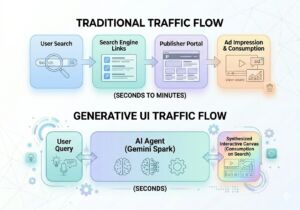
Through tools like the Intelligent Search Box and Ask YouTube, consumer search is no longer a path to external links. Instead, the search engine dynamically constructs a custom user interface on the fly to fulfill the user’s intent. Gartner predicts a highly disruptive trend: traditional search engine volume is expected to decline by 25% by 2026, with users heavily favoring conversational and agentic interfaces.
The strategic challenge for mid-market media
If audiences can consume rich, synthesized multimedia explanations, interactive comparison tools, and curated summaries without ever clicking through to a publisher’s portal, traditional ad-supported monetization models will collapse. To survive, media houses must transition from keepers of static webpages to API-addressable media engines that feed high-value, licensed content and metadata directly into the agentic ecosystem.
2. Screenless and context-aware consumption
The launch of lightweight, audio-first hardware like Google Audio Glasses highlights a shift away from screen-based media consumption. Deloitte’s Digital Media Trends report reveals that 54% of Gen Z and Millennial consumers prefer ambient, highly interactive, and non-intrusive content formats over traditional, passive video streaming.
When users navigate the physical world with ambient audio overlays, media consumption becomes context-dependent, location-aware, and biometric-adaptive:
- Biometric-Responsive Media: By integrating real-time data from smartwatches and connected sensors, media feeds can adapt in real time. An ambient news brief or podcast can adjust its pacing, tone, and musical backing based on whether the user is calmly walking through a park or rushing to a meeting.
- Spatial and Visual Overlay Feeds: As users look at historical sites, retail environments, or sporting events, their glasses capture visual data, match it with spatial maps, and stream highly contextual audio narratives directly into their ears. This opens up entirely new advertising and content formats—such as location-based auditory branding and hyper-local historical storytelling.
Strategic course corrections for media leaders
To thrive in an ecosystem governed by autonomous background agents and dynamic interface synthesis, mid-market media houses must execute immediate operational and technological pivots.
The following three course corrections outline the technical architecture and engineering methodologies required for this transition.
Course correction 1: Transitioning to modular, API-addressable rich media repositories
Media houses can no longer treat video, audio, and text as flat, monolithic files sitting in unstructured cloud storage. To feed autonomous agents (like Gemini Spark) and dynamic search layouts, media assets must be broken down, deeply structured, and made accessible via semantic APIs. Deloitte estimates that companies implementing unified metadata structures and semantic content networks experience a 30% reduction in time-to-market for new content assets.
The Engineering Mandate:
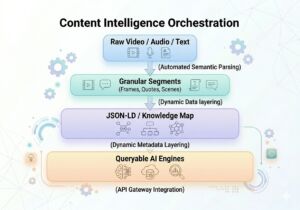
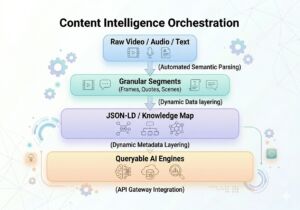
Media publishers must implement an automated, high-velocity asset enrichment pipeline. Raw video footage, podcasts, and written articles must undergo automated structural fragmentation, frame-by-frame semantic tagging, and taxonomy alignment.
To learn more about how to systematically structure, enrich, and deliver high-volume content for automated ecosystems, consult the architectural guidelines in Smart Content Transformation & Delivery.
Technical Implementation Blueprint:
- Deconstruct Media into Atomic Nodes: Programmatically parse video files into semantic segments (e.g., individual scenes, dialogue exchanges, thematic segments) and audio files into discrete, quote-level transcripts.
- Generate Dynamic Metadata Layers: Apply rich, automated schema.org and JSON-LD markup to every node. Tag segments with precise categories: speaker sentiment, visual style, key concepts mentioned, and demographic target profiles.
- Deploy Semantic Query APIs: Expose your media repository via secure, low-latency Vector Search APIs. When an agent queries a specific topic, your system must deliver the precise, pre-fragmented 15-second video clip and its corresponding transcript, ready to be embedded directly into a Generative UI canvas.
Course correction 2: Creative automation and multi-agent production workflows
To match the production velocity of the Agentic Era without exponentially increasing headcount, mid-market media houses must automate their internal creative pipelines. This requires building custom plugins and integrating existing creative tools (like Adobe Premiere, After Effects, and internal CMS portals) directly with background AI agents.
According to research from the Harvard Business Review (HBR) on human-AI collaboration, organizations that deploy unified multi-agent systems to assist creative professionals report a 40% gain in speed-to-market for digital campaigns, combined with a 25% increase in total creative output.
The Engineering Mandate:
Develop custom integration layers, software development kits (SDKs), and specialized plugins that enable creative teams to orchestrate multi-agent background pipelines directly from their native editing environments via standardized protocols such as the Model Context Protocol (MCP).
To explore how to engineer these custom integration layers, AI plugins, and automated media workflows, refer to the development frameworks detailed in AI-First Product Engineering & Creative Automation.
Technical Implementation Blueprint:
- Build Custom Creative App Plugins: Develop dedicated panels within tools like Adobe Premiere or After Effects that connect directly to your private enterprise LLM. Editors should be able to trigger complex background tasks without leaving their timeline.
- Orchestrate Multi-Agent Video Assembly Pipelines: Set up automated production pipelines where:
- Agent 1 (Visual Analyst): Scans raw daily footage, categorizing clips by scene, lighting, and audio quality.
- Agent 2 (Localization & Voice Synthesis Specialist): Translates spoken dialogue, generates natural-sounding localized voiceovers matching the original speaker’s vocal characteristics, and burns in perfectly timed, culturally adapted subtitles.
- Agent 3 (Compliance & Brand Guardrail Agent): Scans the final cut for copyrighted background music, brand guideline violations, and regional compliance issues, automatically generating an audit log.
- Implement Natural-Language Internal Tooling (“Vibe Tools”): Provide a “vibe coding” interface within your internal CMS, allowing editorial teams to spin up custom scripts (e.g., “Write a script that extracts all landscape shots from our travel series, resizes them to 9:16 portrait format for social media, and adds a soft background blur”).
Course correction 3: Dynamic multi-format packaging and fluid media canvases
As consumption devices transition from traditional web pages to highly responsive Generative UI panels on desktop and mobile, and screenless audio on smart glasses, media layouts must become fluid, programmatic, and decoupled from static dimensions.
The Engineering Mandate:
Decouple media assets from their containers. Design teams must establish programmatic layout engines and automated packaging pipelines that dynamically format text, image overlays, interactive widgets, and ad units to fit arbitrary screen sizes or sensory interfaces instantly.
For an in-depth look at how to build high-velocity, automated digital layouts and programmatic multi-device delivery systems, see the methodologies outlined in Specialized Layout & Design Automation.
Technical Implementation Blueprint:
- Transition to Liquid Grid Assets: Store visual graphics, title cards, and promotional materials in highly flexible SVGs or object-layered digital formats. This allows layout engines to dynamically rearrange elements, change typography sizes, and swap background colors based on system parameters (such as the user’s active dark/light mode or localized viewport).
- Deploy Automated Ad-Insertion Engines: Replace static ad blocks with dynamic, contextually generated ad units. When an asset is delivered to a viewer, the layout engine must synthesize a visually harmonious sponsored integration that matches the surrounding editorial aesthetic.
- Develop Multi-Sensory Responsive Packaging: Program your distribution pipelines to dynamically output different media structures depending on the detected device type. For instance, if the endpoint is a smart browser, deliver a high-impact, interactive video-article hybrid; if the endpoint is a pair of screenless smart glasses, automatically convert the same asset into a spatial, biometrically-paced audio narrative.
The path forward
The Agentic Gemini Era presents both an existential risk and an unprecedented scaling opportunity for mid-market media organizations. Those that persist in manual, linear production workflows and rely strictly on drawing static page views to walled platforms will find themselves increasingly disintermediated by autonomous personal agents and real-time Generative UI frameworks.
Conversely, media companies that act decisively to modularize their rich-media libraries, automate post-production via custom creative plugins, and adopt liquid multi-device delivery formats will establish themselves as the primary, authoritative sources of the next-generation digital ecosystem.
The blueprint for the future of media is clear: move beyond flat video files and static platforms, and transition toward a modular, API-first network of intelligent media assets.
