


Executive summary
Enterprise AI has evolved from static models to autonomous, multi-agent ecosystems executing complex workflows. However, this shift has triggered a corporate governance crisis: shadow operations, where autonomous agents call APIs and alter system states on their own. This creates a severe discovery gap, leaving organizations blind to real-time algorithmic actions.
This gap collides with a new regulatory reality. The Reserve Bank of India’s draft “Guidance on Regulatory Principles for Model Risk Management, 2026” enforces live, programmatic accountability across all regulated entities (REs), including commercial banks, non-banking financial companies (NBFCs), cooperative banks, and payment banks—under a strict, board-governed risk umbrella.
For executives managing business growth, operational resilience, and digital delivery, treating this mandate as a standard check-the-box compliance exercise is a strategic misstep. The guidelines fundamentally redefine vendor procurement, operational delivery lines, and customer-facing product designs.
Crucially, the RBI dictates that accountability cannot be outsourced. REs retain full liability for the outcomes of third-party models, fintech APIs, and decentralized SaaS platforms. This eliminates the legacy procurement defense of treating vendor models as proprietary black boxes.
To thrive under this zero-trust validation regime, organizations must pivot from unchecked algorithmic deployment to automated, auditable, and resilient model governance.
This executive blueprint outlines the operating principles, governance architecture, and implementation priorities required to transform regulatory readiness into long-term competitive advantage.
Understanding RBI’s 2026 model risk management framework
To successfully navigate this new regulatory reality, engineering and risk management teams must fully grasp the four non-negotiable operational controls mandated by the regulatory framework, designed to mitigate risks ranging from generative hallucinations to malicious adversarial injections:
The mandated “kill switch”
Regulated entities must implement runtime controls, including an automated “kill switch” mechanism. This enables immediate override, suspension, or deactivation of any AI model if its outputs breach predefined business thresholds, produce errors, or exhibit erratic behavior.
Board-approved model risk management framework (MRMF)
Every deployed model must be cataloged within a comprehensive registry governed by an explicit, board-approved MRMF. High-risk models require formal authorization from the Risk Management Committee of the Board (RMCB) prior to production deployment.
Independent validation and the three lines of defense (3LoD)
The framework demands a strict separation of duties:
- First line: Model owners and operations teams who build and run the tools.
- Second line: An independent Model Risk Management (MRM) team responsible for challenging and validating the logic.
- Third line: Internal audit teams providing objective assurance directly to the Board.
State-preserving consumer disclosures
Any consumer-facing conversational AI agent, chatbot, or automated voice interface must explicitly state that the user is interacting with an algorithm. Furthermore, the system must provide a seamless, real-time mechanism to bypass the AI loop and connect with a live human representative at any stage of the interaction.
Why this mandate extends beyond compliance
Treating the 2026 mandate as a routine legal checkbox is a severe strategic miscalculation; it is an infrastructure transformation directive. In an era of agentic AI, shadow operations allow autonomous systems to modify execution paths and call unmonitored APIs in real time, bypassing legacy logging.
The RBI addresses this discovery gap by mandating continuous runtime visibility. For financial institutions, non-compliance risks immediate operational shutdowns. For fintech SaaS providers, exposing verifiable data lineages and API override hooks is now a commercial requirement. Proactive organizations will compress procurement cycles and convert a regulatory cost center into a resilient foundation for digital innovation.
Related: Why AI transformations fail before they begin
Direct operational impact & the friction matrix
The intersection of these regulatory requirements creates structural friction points across legacy operational motions. Understanding this friction is essential for engineering compliant systems that do not compromise business delivery velocity.
Table 1: The multi-sided enterprise friction matrix
| Stakeholder vector | Primary operational pain point | Imminent risk under the 2026 draft | Required technical pivot |
| Enterprise financial institutions | Proliferation of uninventoried shadow AI and fragmented model deployments across isolated business teams. | Massive regulatory fines, personal board liabilities, and the abrupt shutdown of core, revenue-generating automated pipelines . | Establish a centralized, automated model registry portal ; inject programmatic runtime visibility loops ; deploy human-in-the-loop validation layers . |
| B2B fintech and SaaS providers | Extended enterprise procurement delays, prolonged security reviews, and sudden vendor onboarding rejections . | Widespread customer churn and immediate contract terminations by tier-one banks shedding unvalidated vendor models . | Engineer compliance-by-design application architectures ; expose automated state rollback endpoints, open audit lineages, and override APIs . |
Building an agentic governance layer
To avoid manual, slow-moving compliance workflows that cripple product velocity, organizations must pivot toward automated, code-driven risk mitigation. The optimal architectural pattern to achieve this is the deployment of an Agentic Governance Middleware (AGM) layer.
Related: Why high-stakes regulatory workflows demand deterministic engineering
The middleware acts as a decoupled, isolated proxy layer that wraps around autonomous multi-agent pipelines. Instead of allowing autonomous models to interact directly with core enterprise record databases or customer-facing user interfaces, the middleware intercepts all data inputs and execution payloads in real time. It verifies data types, evaluates model drift, enforces mathematical guardrails, and ensures strict data lineage tracking before any transaction achieves finality.
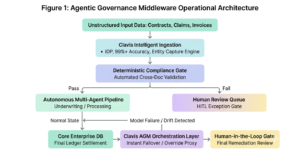
By standardizing this runtime control loop, the enterprise gains complete visibility into every programmatic action, solving the shadow operations problem by forcing autonomous workflows to run within a bounded, deterministic environment.
Five implementation pillars: engineering compliance by design
Transforming the theoretical mandate into a resilient software architecture requires executing five foundational engineering pillars.
Pillar 1: Automated model inventorying and risk tiering
The regulatory framework establishes that any uncataloged calculation engine, legacy script, macro-enabled spreadsheet, or third-party API is a severe compliance liability . Organizations must build a centralized, single-sign-on-integrated model governance command center that serves as an immutable master registry .
To eliminate subjective human bias during vendor assessments, the platform uses a deterministic sorting matrix that automatically evaluates every system across three core operational fields :
- Algorithmic complexity. Classifying whether the component is a deterministic, rule-based calculator, a traditional machine learning scoring model, or a highly stochastic, generative multi-agent system .
- System autonomy. Determining whether the model operates in a purely advisory capacity to a human specialist, or functions autonomously with direct system-to-system write privileges.
- Business and customer impact. Calculating the aggregate downstream financial risk, data privacy footprint, or credit access implications if the model yields a faulty or biased output.
Models that incur high cumulative risk metrics are programmatically locked at the CI/CD pipeline level. They are prevented from launching into production environments until a formal multi-stage approval workflow is satisfied and logged for board review.
Pillar 2: Engineering the real-time “kill switch” and failover orchestration
Manual code deployments, server restarts, or manual operational interventions are too slow to halt an unstable AI model processing hundreds of automated transactions per second.
The Operational Shift
Implement a low-latency gateway between application databases and AI model endpoints. This architectural component functions as an automated safety net.
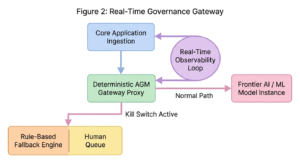
The gateway records every model interaction and monitors latency, formatting, and mathematical outputs against business baselines. If real-time monitoring detects anomalous patterns, significant data drift, or error rates that breach preset operational limits, the gateway triggers an immediate deactivation loop (the Kill Switch).
Rather than throwing a fatal error and crashing the customer application, the gateway automatically diverts processing traffic to a reliable, rule-based fallback engine or places the transaction into a high-priority human review queue, keeping business operations moving smoothly.
Pillar 3: AI-first document extraction with immutable verification
Unstructured document extraction (e.g., parsing insurance policy papers, KYC documents, loan applications, or commercial invoices) frequently relies on advanced language models that can occasionally hallucinate data. Unchecked extraction pipelines create significant regulatory exposure.
The Operational Shift
Isolate automated extraction engines from your primary business databases using an automated validation gate. This pipeline uses a hybrid architecture that combines intelligent document processing with structured verification checks.
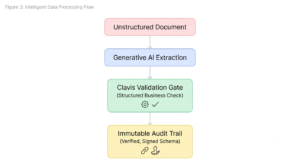
The system ingests unstructured text, converts it via document intelligence models, and immediately passes the output to a rule-based validation gate. This gate runs clear business checks to verify data types, mathematical totals, and cross-document consistencies (such as matching an invoice total to a purchase order).
Approved extractions are compiled into highly structured, verified digital formats accompanied by audit stamps. This ensures a transparent, step-by-step audit trail that satisfies regulatory compliance reviews while keeping manual data entry work down to a minimum.
Pillar 4: Stateful customer conversational architecture
Standard setups for customer-facing conversational agents often fail to meet transparency guidelines and lack robust, state-preserving human escalation routing.
The Operational Shift
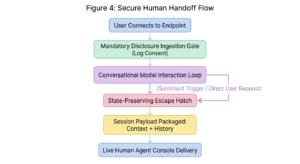
Re-engineer the orchestration layer handling conversational sessions. Chat and voice applications must utilize an integrated conversational routing framework connected directly to enterprise contact center systems.
- Mandatory disclosure ingestion. The session must initialize by presenting a clear greeting that explicitly states the user is communicating with an AI agent, outlines the operational boundaries of the tool, and logs user acknowledgment to an immutable audit file .
- Context-preserved escape hatch. If background sentiment analysis flags intense customer frustration, or if the client explicitly invokes a help prompt, the conversational loop triggers a stateful escape mechanism .
- Stateful transition. The session payload manager packages the entire conversational history, intent vector maps, and active system prompts into a secure JSON schema . This payload is injected via webhooks directly into a live agent’s service console, ensuring a smooth handoff without forcing the customer to repeat information .
Pillar 5: Independent adversarial probing and model validation routine
The RBI framework clarifies that automated vendor-provided security checklists or basic static vulnerability scans are no longer sufficient to prove compliance.
The Operational Shift
Establish a formalized Adversarial Probing and Model Validation Routine managed independently of development pipelines.
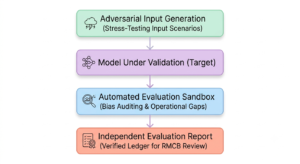
Organizations must establish testing routines to execute continuous operational stress tests and system validation tailored for automated workflows.
Validation teams stress-test models using edge-case data entries, corrupted data variations, and unusual input scenarios. The results of these tests are compiled into verified audit logs, providing the independent documentation required for regulatory reviews and internal audit verifications.
The 12-week operational playbook for regulated entities and SaaS providers
Achieving complete alignment with the 2026 Model Risk Management mandate requires executing a highly structured, phased implementation playbook over a twelve-week horizon .
Weeks 1–3: Comprehensive model discovery and estate audit
- Scan system architectures: Run automated asset discovery tools across all enterprise code repositories and infrastructure environments to map every active calculation tool, shadow script, and external third-party fintech API endpoint .
- Conduct operational interviews: Audit distinct business units including credit underwriting, risk operations, customer service channels, and collections teams to uncover undocumented, localized tools .
- Initialize the central registry: Document every discovered model asset within the master repository, capturing explicit business ownership, model intent, version histories, and core system dependencies .
Weeks 4–6: Framework codification and risk tiering
- Establish classification parameters: Codify the enterprise risk classification matrix based on institutional risk appetites and corporate governance baselines .
- Execute tiering pass: Route the full discovered model inventory through the governance dashboard, programmatically tagging high-risk pipelines that require board-level authorization .
- Structure the lines of defense: Formally separate operations and development personnel from the second-line independent validation and audit functions to eliminate conflicts of interest .
Weeks 7–10: Deploying the AGM gateway and control infrastructure
- Inject proxy middleware: Deploy the low-latency middleware proxy layer between core transactional systems and internal or external model endpoints.
- Configure fallback orchestration: Map out and test deterministic fallback logic, rule-based engines, and automated human routing workflows for all high-risk systems .
- Re-engineer client interfaces: Implement mandatory disclosure prompts and state-preserving conversational escape hatches across all production chat and voice systems.
Weeks 11–12: Vendor re-papering and regulatory alignment
- Audit service level agreements: Review all third-party fintech and software contracts, appending strict clauses that mandate full data lineage transparency and access to validation documentation.
- Enforce data localization: Ensure contract structures protect supervisor audit rights and conform to regional data localization mandates.
- Secure board sign-off: Package the initial model risk management framework implementation report and submit the consolidated data to the board for formal authorization.
Post-week 12: Continuous operational validation
- Execute kill-switch drills: Conduct scheduled quarterly automated drills to evaluate system resilience and verify that fallback paths activate correctly under simulated model crashes.
- Perform drift assessments: Run automated data evaluations prior to deploying software updates or when encountering significant changes in primary upstream data pipelines.
- Maintain historical records: Retain an unalterable archive of all active and decommissioned models for a minimum retention window of ten years to ensure historical traceability during future audits.
Operational readiness checklist
Corporate executives can utilize this diagnostic tool to immediately evaluate their organization’s regulatory exposure and operational readiness ahead of enforcement deadlines :
- System ledger: Do you maintain a centralized, single-source-of-truth registry that tracks every active mathematical model, automated script, macro-enabled spreadsheet, and external fintech API active across the organization?
- Architectural intercept: Does your software engineering stack include a decoupled runtime proxy capable of programmatically terminating or redirecting an unstable or drifting AI model session within milliseconds?
- Vendor auditing: Do your third-party business contracts include clear, legally enforceable clauses granting internal validation teams unhindered access to system code lineage and backend documentation?
- Consumer escape: Do your client-facing automated conversational applications provide a clear AI interaction disclosure alongside an immediate, state-preserving human handover option ?
- Governance isolation: Is your second-line model validation and risk management function operationally and financially decoupled from your primary application development and operations teams?
From regulatory compliance to competitive advantage
Viewing the 2026 Model Risk Management mandate purely as an intrusive regulatory hurdle overlooks its immense strategic potential. In an environment where algorithmic stability directly impacts financial solvency and public reputation, establishing automated, resilient governance controls is a profound business differentiator.
For financial services organizations, deploying a centralized agentic governance middleware layer provides unprecedented operational transparency, enabling leadership to optimize workflow efficiencies and scale autonomous multi-agent pipelines safely, securely, and sustainably. For B2B software vendors and fintech providers, embedding these rigorous compliance-by-design structures directly into application architectures dramatically accelerates enterprise procurement timelines, shortens security evaluation reviews, and positions products as the lowest-risk options for institutional buyers.
Compliance is no longer a post-development check-the-box routine; it is an foundational engineering discipline. By partnering with Clavis Tech, organizations can integrate advanced risk observability with automated engineering controls, ensuring their AI transformations remain completely secure, scalable, and resilient.
