


Unlocking enterprise value with smart content transformation
In the digital-first business landscape, content is an invaluable asset. Organizations possess vast repositories of institutional knowledge, technical documentation, research papers, legal contracts, and product manuals. However, much of this content is locked away in “dumb” formats—such as unstructured PDFs, legacy Word documents, scanned files, or poorly formatted HTML.
These flat formats are static and siloed. They cannot be easily searched, updated, personalized, or distributed across modern multi-channel platforms (such as mobile apps, voice assistants, smart devices, and headless web frontends).
To unlock the true value of their information, enterprise publishers and technology leaders are turning to smart content transformation and delivery. This involves engineering automated semantic pipelines that ingest unstructured legacy formats, analyze their meaning, restructure them into standardized, metadata-rich XML or JSON schemas, and deliver them dynamically across any digital channel.
This blog details the engineering architectures, semantic parsing techniques, and delivery paradigms that power modern content transformation pipelines.
The anatomy of an enterprise content transformation pipeline
An enterprise-grade content transformation pipeline must operate with high throughput and strict semantic accuracy. It cannot rely on manual copy-pasting or basic regex scripts. Instead, it must combine advanced file parsing, machine learning, and schema validation.
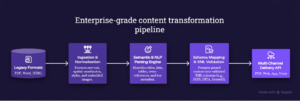
Step 1: Ingestion and normalization
The first phase involves stripping away file-specific wrappers. Whether the source is an Adobe InDesign package, an old .doc file, or a vector PDF, the pipeline ingests the file and normalizes it into a consistent raw data stream. For PDFs, this involves extracting not just the characters, but their exact Cartesian coordinates, font sizes, and spatial relationships on the page.
Step 2: Semantic analysis and structure extraction
Raw text extraction is flat; it does not tell you if a line of text is a section header, a table caption, a list item, or an inline note. Modern pipelines utilize Natural Language Processing (NLP) models and spatial heuristics to infer the hierarchical structure of the document.
By analyzing visual clues (such as line spacing, font weight, and numbering conventions) and linguistic cues, the parsing engine constructs a structured Document Object Model (DOM) representing the logical outline of the content.
Step 3: Schema mapping and validation
Once the document structure is understood, the content is mapped to a strict target schema. In professional publishing, these schemas are highly standardized:
- DITA (Darwin Information Typing Architecture): Ideal for modular, topic-based technical documentation.
- JATS (Journal Article Tag Suite): The global standard for scientific, technical, and medical (STM) journal publishing.
- S1000D: Used globally in aerospace, defense, and heavy equipment manufacturing for technical manuals.
The mapped content is run through rigorous XML Schema Definition (XSD) and Schematron validation engines. These engines act as automated quality gates, ensuring that every element—from paragraph tags to complex mathematical equations—complies with strict organization-wide data specifications.
Navigating the complexities of semantic extraction
Transforming unstructured text into structured data is filled with engineering landmines. Two areas are particularly challenging: handling tabular data and extracting rich metadata.
The challenge of tabular data
Tables are designed for human visual consumption, not machine parsing. In unstructured documents (especially PDFs), tables often lack clear grid lines, or contain complex row spans, column spans, and nested headings.
To programmatically reconstruct a table into a valid HTML <table> or CALS XML structure, the parsing engine must perform spatial clustering. By analyzing the alignment of text bounding boxes, the system calculates grid coordinates and mathematically reconstructs the rows and columns, preserving the precise relational integrity of the data points.
Visual PDF Layout: Parsed Logical Representation:
———————————- [Table]
| Region | Sales 2025 | Q1 2026| [Row]
———————————- [Cell: Region]
| North | $1.2M | $400K | [Cell: Sales 2025]
| South* | $900K | $310K | [Cell: Q1 2026]
———————————-
*Includes regional office adjustments. [Footer: *Includes regional…]
Automated metadata enrichment
Structured content is only as good as its metadata. A smart transformation pipeline doesn’t just output structured paragraphs; it actively enriches the content.
Using specialized NLP and Named Entity Recognition (NER) models, the pipeline scans the content during transformation to:
- Identify and tag key entities (such as product names, legal jurisdictions, or medical compounds).
- Extract abstract summaries and generate relevant semantic keywords.
- Apply taxonomy codes based on standardized industry classification lists.
This metadata is embedded directly into the header of the transformed XML/JSON files, making the content highly discoverable and ready for semantic search engines.
Designing a modern headless delivery architecture
Once content is transformed into structured, metadata-rich formats, the focus shifts to delivery. Traditional publishing platforms coupled content with a specific presentation layer (such as a CMS that only renders desktop web pages). Modern delivery architectures are completely decoupled—using a headless delivery engine.
In a headless delivery model, the validated XML or JSON content is stored in a centralized cloud repository. When a digital channel requests content, the delivery engine processes it on demand:
- Web and mobile apps: An API serves lightweight JSON payloads that are dynamically rendered by modern front-end frameworks (React, Swift, Kotlin).
- Print and PDF distribution: The structured XML is passed through an XSL-FO (Extensible Stylesheet Language Formatting Objects) or CSS Paged Media engine to compile highly precise, print-ready PDFs.
- AI and LLM integration: Clean, structured content is fed into search indexes and Retrieval-Augmented Generation (RAG) databases, serving as a highly reliable, hallucination-free knowledge base for customer-facing AI agents.
Content as a strategic asset
Unstructured information is a silent bottleneck in enterprise operations. It slows down search, increases editing costs, and limits delivery to legacy platforms. By engineering robust, NLP-driven ingestion pipelines, mapping content to rigorous industry-standard schemas, and deploying modular, headless delivery engines, organizations can treat their content as a highly fluid, scalable strategic asset. Transitioning to smart content transformation and delivery is the definitive way to future-proof enterprise knowledge and deliver it to any screen, app, or system instantly.
If your organization is ready to eliminate manual transformation bottlenecks and unlock the full potential of your institutional data, connect with our content engineering specialists at Clavis Tech today to architect a custom, high-velocity semantic pipeline.
