


Executive Summary
As enterprises accelerate AI adoption in 2026, success will depend less on deploying more intelligent models and more on orchestrating them effectively across complex business operations. For organizations in scientific and scholarly publishing, enterprise creative operations, and industrial manufacturing, fragmented workflows, legacy systems, and disconnected data continue to limit the scalability and business value of AI.
This executive playbook outlines a strategic blueprint for building AI-native orchestration that unifies intelligent workflows, publishing automation, and enterprise governance.
As technology and operations leaders, you will gain practical insights into overcoming common barriers to enterprise AI adoption, designing resilient orchestration architectures, modernizing legacy environments without disruption, and creating trusted automation frameworks that deliver measurable improvements in productivity, quality, compliance, and long-term operational efficiency.
The new operating reality for document-intensive enterprises
The core of enterprise business process execution is being fundamentally redefined. Organizations that previously relied on task-specific software silos are discovering that manual asset transformation cannot keep pace with the hyper-accelerated digital demands of 2026. Content pipelines have evolved from static document storage into dynamic, continuous data ecosystems that require real-time modification, instant rendering, and multi-platform dissemination.
The operational pressures driving transformation
Across specialized sectors, distinct market vectors are forcing an infrastructure-level overhaul. In scholarly publishing, open-access business models require near-instantaneous manuscript-to-market processing times without allowing structural errors to compromise corporate margins. Simultaneously, global creative operations are overwhelmed by an unprecedented explosion of content variants designed for deeply fragmented digital advertising channels. In the industrial sphere, engineering teams must maintain technical manuals that update autonomously alongside real-time machinery configurations.
Why AI is becoming a business necessity
In this accelerated operational environment, intelligence-driven operations have shifted from an experimental competitive luxury into a baseline requirement for institutional survival. Relying on expanded human headcount to resolve document processing inefficiencies is no longer viable due to compressing market timelines and a tightening global labor market. Scalable market growth can only be sustained by embedding computational intelligence directly into the connective tissue of corporate data pipelines.
The common challenge across content-driven enterprises
While scientific publishing, global creative operations, and heavy manufacturing seem functionally distinct, they share an identical set of core operational vulnerabilities that stall digital progress:
- Legacy systems: broken data architectures and outdated backend platforms hold vital business rules but lack native capabilities to connect with modern applications.
- Complex workflows: multi-departmental handoffs create persistent visibility gaps, leading to severe project delays and budget overruns.
- Compliance: strict regulatory guidelines, data integrity mandates, and localized validation protocols require continuous, resource-intensive oversight.
- Human review: critical production pipelines remain heavily dependent on manual editing, basic formatting, and proofreading loops.
- High document volumes: millions of structured and unstructured assets pass through corporate networks daily, overwhelming legacy processing capacities.
- Disconnected tools: fragmented point solutions force teams to execute repetitive manual data transfers between incompatible applications.
- Knowledge silos: invaluable domain experience remains trapped within individual departments or retiring staff, threatening institutional continuity.
These organizations do not need isolated AI point solutions—they require comprehensive, orchestrated operations.
Why traditional automation is no longer enough
The early enterprise enthusiasm for generative AI has faced a strict market correction. Technology leaders have realized that deploying separate, uncoordinated digital applications generates a state of automation purgatory. In this state, specific tasks run faster, but the broader end-to-end operational pipeline remains fragmented, brittle, and dependent on human labor to bridge the gaps between tools.
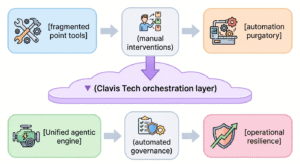
The limits of standard robotic process automation
Traditional Robotic Process Automation (RPA) excels at executing rigid, unchanging user interface tasks. However, traditional RPA breaks the moment it encounters unstructured data formats, variable layouts, or contextual anomalies. Standard scripts cannot adapt to an incomplete scientific manuscript, an unformatted marketing asset, or an altered engineering spec sheet. This rigid architecture forces systems to continuously flag exceptions, routing workflows back to human teams and recreating operational friction.
Point-solution tool fatigue and human bottlenecks
The rapid acquisition of narrow AI applications has introduced severe corporate tool fatigue. Employees spend their productive hours jumping between isolated document processors, standalone cloud folder systems, and independent AI portals. This architecture turns human workers into manual data routers, forcing them to copy, format, and verify information across disparate software environments. This fragmentation delays time-to-market metrics and leaves organizations vulnerable to an ongoing global IT skills gap.
The shift to AI-native orchestration
The enterprise landscape is transitioning decisively toward agentic AI. This model represents a shift from passive software tools that merely retrieve data or generate text to autonomous systems that independently reason, map out execution plans, and run multi-step workflows. AI-native orchestration integrates these cognitive capabilities directly into corporate infrastructure, establishing a unified system that manages data transformation from ingestion to final multi-platform delivery.
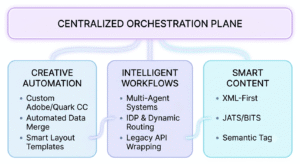
The power of multi-agent collaboration
Unlike single-agent tools that fail when confronted with enterprise scale, orchestrated ecosystems employ teams of specialized AI agents that collaborate using agent-to-agent (A2A) communication protocols. Each agent manages a distinct, bounded capability within the processing pipeline:
- The ingestion agent: extracts and structures content from incoming raw files.
- The verification agent: runs background data checks, structural audits, and compliance validation.
- The creative agent: applies style sheets, handles data merge actions, and builds high-fidelity layouts.
- The distribution agent: translates and packages the final asset for diverse digital channels.
Redefining human capital as exception managers
By automating repetitive operational tasks, AI-native orchestration shifts human workers away from routine processing loops. Employees transition into strategic exception managers. They step in only when the orchestration engine flags a complex anomaly, reviews a high-risk compliance alert, or authorizes a final publication gate. This approach maximizes human creativity while eliminating operational bottlenecks.
The AI-native orchestration reference architecture
To safely deploy multi-agent systems at scale, enterprises must transition to a standardized, modular reference architecture. This blueprint acts as the stable foundation for all automated operations:
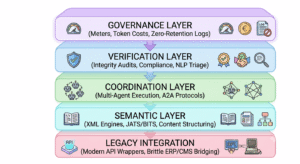
Governance layer
The governance layer manages security, system visibility, and resource deployment. It tracks system metrics via real-time dashboards, optimizes token consumption, and enforces strict data residency boundaries. This layer protects corporate intellectual property by running zero data retention architectures, ensuring proprietary data is never used to train external models.
Verification layer
The verification layer automates quality control and regulatory compliance. It runs automated plagiarism checks, detects data manipulation, reviews brand alignment, and checks formatting against pre-set rules. It operates as an automated editor, passing approved assets downstream while routing errors to human exception managers.
Coordination layer
The coordination layer serves as the command center for multi-agent workflows. It manages task distribution, tracks agent status, and route assets along optimized process paths. This layer relies on A2A communication protocols to ensure diverse tools pass data cleanly without dropping context or requiring manual intervention.
Semantic layer
The semantic layer handles content structuring and contextual intelligence. It instantly reads ingested data, converts unstructured text into standardized XML formats, and injects metadata tags. By establishing an XML-first data model early, this layer ensures assets remain readable by both humans and AI models.
Legacy integration
The legacy integration layer connects modern AI capabilities with brittle, older enterprise platforms. Instead of executing a high-risk infrastructure replacement, this layer builds secure API wrappers around legacy databases and software. This lets the orchestration engine draw data out and push results back into core enterprise applications without destabilizing production systems.
Five core capabilities of AI-native orchestration
Implementing an AI-native reference architecture provides five essential operational capabilities:
1. Intelligent workflow orchestration
This capability turns fragmented, manual handoffs into unified automated processes. It coordinates complex workflows across corporate silos, automatically balancing processing loads and re-routing tasks to maintain optimal pipeline speed.
2. Document & data intelligence
Using advanced Intelligent Document Processing (IDP) and machine learning, this capability extracts data from unstructured documents, old layouts, and messy catalog inputs. It normalizes this data into clean corporate assets with zero manual copying.
3. Publishing automation
This capability automates precision design tasks within systems like Adobe Creative Cloud and QuarkXPress. It uses custom programming scripts and data-driven templates to dynamically scale text layouts, format complex technical math notation, and generate thousands of localized documents instantly.
4. Legacy modernization
This capability extracts and documents valuable business rules buried deep inside older corporate codebases. By translating these legacy parameters into flexible microservices, it modernizes your enterprise technology stack without disrupting current revenue engines.
5. AI governance
This capability provides comprehensive operational tracking and absolute security guardrails. It logs every step of an automated decision, flags compliance exceptions, and protects data privacy through token-level access monitoring.
The next era of content & publishing operations
Deploying AI-native orchestration requires identifying industries burdened by high content volume, technical debt, and strict compliance demands. In 2026, three primary industry segments present the most critical need for automated workflow solutions:
1. Scientific, technical, and medical (STM) publishing
Publishers are facing intense systemic pressures, including the escalation of research integrity threats such as paper mills and data manipulation. This occurs alongside the rapid transition to open-access business models and a growing demand for high-speed, structured BITS/JATS XML production. Survival in this sector requires accelerating manuscript-to-market timelines without diluting structural validation safeguards.
2. Global enterprise creative and marketing
Modern marketing departments face an explosion of digital platforms requiring adaptive layout scaling across thousands of distinct assets. Managing a standardized brand identity across global channels has created severe “tool fatigue” resulting from disjointed creative software stacks.
3. Industrial manufacturing and engineering
As global operations transition to software-defined environments, manufacturing firms must manage complex technical documentation synchronized with real-time digital twin changes. Automating parts catalogs and multi-lingual technical specs with precision-critical typesetting is essential to maintaining global supply chain efficiency.
How Clavis Tech solves the orchestration impasse across specialized domains
As a premier provider of advanced system integration and intelligent workflow solutions, Clavis Tech builds the foundational architecture required to close the capability-deployment verification gap. By engineering high-fidelity digital engines, Clavis Tech transforms vulnerable corporate data stores into secure, resilient, and highly automated ecosystems.
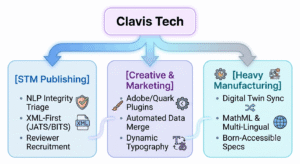
To move beyond fragmented task automation, Clavis Tech delivers an integrated technical framework that acts as the connective tissue of the modern enterprise.
1. Reconciling high-volume publishing with research integrity
To accelerate manuscript-to-market speed by 80% while strengthening safeguards against paper mill fraud, Clavis Tech deploys automated triage systems utilizing natural language processing (NLP). These engines execute immediate plagiarism, style, and accuracy audits at ingestion, filtering out low-risk tasks. By mandating a BITS/JATS-compliant XML-first workflow, the system automatically validates the structure of scientific notation and data references (such as MathML) before the asset ever reaches the layout stage. Multi-agent systems then optimize peer-reviewer recruitment to clear processing bottlenecks, while centralized, unalterable logs provide full compliance visibility.
2. Overcoming creative silos and tool fatigue
Clavis Tech consolidates isolated creative applications into a unified production pipeline that governs an asset’s entire lifecycle. By engineering custom plugins and scripts directly inside professional design environments like Adobe Creative Cloud and QuarkXPress, Clavis Tech eliminates formatting human error by up to 100%. Using advanced data merge technologies, unstructured database files convert into high-fidelity layouts, while embedded smart templates optimize typography and layout aesthetics based on contextual content analysis.
3. Modernizing legacy stacks and technical layout scaling
For organizations struggling with technical debt, Clavis Tech utilizes AI code analysis to extract and map business rules from undocumented legacy applications, converting those rules into modern microservices. Advanced Intelligent Document Processing (IDP) solutions ingest unstructured invoice data, routing it through secure API wrappers directly into core systems to automate reconciliation.
In manufacturing environments, this content transformation engine connects directly to the product digital twin. As engineering changes occur, the technical documentation automatically adapts across global languages and accessibility standards.
To meet strict 2026 security requirements, Clavis Tech enforces zero data retention architectures for prompt logs, ensuring sensitive corporate intelligence is never stored or used to train external language models.
Quantitative evaluation: performance metrics and operational return on investment
Transitioning from siloed task automation to an engineered, agentic AI orchestration model yields measurable improvements across core operational dimensions. The following benchmark analysis outlines the performance shifts experienced by enterprises adopting a coordinated architecture:
| Operational metric | Legacy manual / fragmented processes | Engineered agentic orchestration framework | Measurable business outcome |
| Production cycle time | Weeks to months for long-form manuscripts and manuals. | Under 24 hours from ingestion to verified multi-channel output. | 90%+ reduction in end-to-end time-to-market metrics. |
| Operational unit costs | Scales linearly with production volume (requires more headcount to scale). | Decoupled from output volume via automated scaling engines. | 30% to 50% reduction in unit processing expenditures. |
| Structural layout error rates | 5% to 10% human typography and formatting errors. | Near 0% due to automated style-sheets and XML validation. | Elimination of compliance errors and formatting vulnerabilities. |
| Routine task handling time | 100% manual intervention for document processing. | 60% to 80% reduction through triage and automated execution. | Optimization of staff focus toward high-value exception management. |
| Enterprise technology TCO | High due to point-solution tool sprawl and integration silos. | Low due to unified orchestration and centralized data layers. | 30% increase in overall operational infrastructure efficiency. |
This structural optimization becomes even more vital when evaluated against the widening global talent shortage. By 2026, 90% of global organizations are directly impacted by the IT skills gap, leading to trillions of dollars in potential losses from delayed digital initiatives.
Resolving this crisis cannot be achieved through aggressive hiring campaigns alone. Instead, Clavis Tech frameworks allow companies to mitigate talent scarcity by using advanced multi-agent systems to capture, formalize, and preserve institutional domain expertise.
The Clavis Tech methodology: moving from pilot volatility to agentic maturity
To systematically transition enterprises from volatile AI experiments to a stable, production-grade operational state, Clavis Tech utilizes a proven deployment roadmap.
Phase 1: the semantic data audit and context discovery
- Workflow inventory mapping isolates operational friction points, manual interventions, and systemic protocol gaps across core business domains.
- Data synchronization structures integrate disconnected, multi-departmental information repositories to remove historical data silos.
- Governance baseline configuration establishes rigorous security, compliance, and taxonomy parameters prior to agent deployment.
Phase 2: isolated line-of-business deployment
- Low-risk operational targets isolate internal functions, such as automated intelligent document processing for invoice intake, to build process muscle safely.
- Handoff parameter validation calibrates deterministic exception gates to guarantee clean transitions between agents and human teams.
- Performance baseline auditing tracks token expenditure, processing speeds, and precision accuracy against target financial metrics.
Phase 3: enterprise scale-out and secure infrastructure expansion
- Horizontal infrastructure expansion deploys synchronized multi-agent frameworks across the broader corporate application ecosystem.
- Zero-data-retention gateway configuration implements strict perimeters to ensure proprietary data is never used to train external models.
- Token-level governance runtime instrumentation meters, attributes, and controls processing consumption to eliminate unexpected infrastructure costs.
Executive priorities for 2026
In the highly competitive landscape of 2026, the divide between market leaders and lagging organizations is determined by their information orchestration strategy. Businesses that depend on disconnected point-solutions will remain confined to automation purgatory, vulnerable to project delays and severe talent shortages.
To establish operational resilience and exit automation purgatory, corporate technology leaders should prioritize the following actions:
- Execute an operational audit: audit current creative and publishing pipelines to identify where manual handoffs and tool fragmentation cause project stalls.
- Enforce structured data standards: mandate XML-first frameworks (such as BITS/JATS) early in the content lifecycle to future-proof assets for AI discovery and multi-channel delivery.
- Wrap rather than replace: isolate brittle legacy systems behind modern API wrappers to capture refined business logic without the risk of a total infrastructure teardown.
- Establish human-in-the-loop gates: build agentic workflows with mandatory human-approval gates and detailed reasoning logs to maintain absolute compliance and institutional trust.
By partnering with Clavis Tech to integrate intelligent workflow orchestration, smart content transformation, and custom creative automation, modern enterprises can structurally reduce TCO, close the IT skills gap via automated knowledge capture, and protect their core intellectual property.
