


The new geopolitical reality of enterprise offshoring
For decades, enterprise executives viewed offshoring through a predictable lens of talent access, cost optimization, and global delivery. However, the global information technology paradigm underwent a structural rupture on June 12, 2026, revealing a massive, unhedged operational risk in modern outsourcing.
The United States Department of Commerce deployed emergency export controls directly targeting Anthropic’s most advanced frontier reasoning models, Claude Fable 5 and Claude Mythos 5. This unprecedented regulatory intervention was triggered by national security concerns over a newly discovered vulnerability that exposed critical software flaws and generated functional exploit code.
In response, the Bureau of Industry and Security (BIS) leveraged the Export Administration Regulations (EAR) to mandate an immediate suspension of access for all foreign nationals globally. Because real-time verification of a remote cloud user’s legal nationality proved technically unfeasible under existing enterprise SaaS frameworks, Anthropic executed an immediate global blackout of these models for all non-US users.
While these restrictions were conditionally lifted on June 30, 2026, after eighteen days of intense negotiation, the incident permanently shattered a dangerous illusion: the belief that global cloud software delivery is immune to geopolitical interference. Concurrently, OpenAI faced similar regulatory interventions, restricting early access to its upcoming GPT-5.6 model to a pre-vetted cohort of domestic partners.
This regulatory volatility represents a profound paradigm shift. The US government now treats commercial frontier AI models with the same regulatory severity as munitions, dual-use military hardware, and advanced semiconductors.
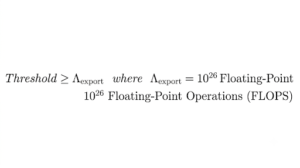
Historically, export controls focused on physical compute chips (such as ECCNs 3A090 and 4A090). Today, the assertion of “is informed” controls under Section 744.22 of the EAR expands extraterritorial authority directly over software outputs and remote cloud access. Under this regime, any model crossing specific computational thresholds is treated as a highly controlled asset. This threshold is mathematically defined by the cumulative computing power used during pre-training:
Key takeaway: Physical data localization within national boundaries is no longer a sufficient defense against cloud disruptions.
Under extraterritorial legal frameworks such as the US CLOUD Act, American technology companies can be legally compelled to surrender data or cut off services even if their servers are physically located in local data centers in Mumbai, London, or Frankfurt.
The hidden liabilities of vendor AI shortcuts
The USD 300 billion offshore IT services industry is undergoing a painful structural transformation. For nearly three decades, the sector’s business model was governed by labor arbitrage: taking routine programming, QA testing, database maintenance, and compliance tasks and routing them to offshore teams to scale headcount.
The rise of agentic AI has permanently broken this correlation, ushering in an era of “non-linearity” where revenue growth is decoupled from headcount expansion. During recent fiscal cycles, major IT players reported growing revenues while their total headcounts remained flat or actively declined. The most acute expression of this trend is seen in mid-cap leaders, some of which grew revenue by approximately 30% in FY26 while employee cost bases increased by only 20%.
To preserve their margins in an era of outcome-based, fixed-price contracts, many legacy offshore providers are rushing to deploy generic AI tools across their developer workforces.
“Legacy offshoring thrived on billing hours for routine tasks. Now, vendors are using generic AI coding assistants as a desperate margin-crutch. They are copy-pasting code from public LLMs to mimic productivity, but they are secretly passing massive sovereign risk, hidden technical debt, and IP liabilities straight down to the enterprise client. At Clavis Tech, we don’t use AI to cut engineering corners; we use it to build robust, independent architectures that protect your business.” – Abdul H. Kidwai, CEO at Clavis Tech
If your technology partner is simply giving their developers generic, US-hosted AI assistants to write your proprietary code faster, they are exposing your business to three critical liabilities:
- Intellectual property leakage: sensitive corporate data, proprietary algorithms, and enterprise logic are constantly uploaded to foreign-hosted cloud models to generate code suggestions.
- Structural fragility: code generated by standard AI assistants is often riddled with hidden dependencies, security vulnerabilities, and licensing risks that standard QA pipelines miss.
- Geopolitically fragile delivery: if the US government enacts sudden API restrictions, your vendor’s development teams will lose access to their primary productivity tools overnight, causing project timelines to stall indefinitely.
To counter these structural dependencies, forward-thinking enterprises are shifting toward specialized staff augmentation services that deploy cross-functional talent pods bound to strict compliance frameworks and ring-fenced development environments.
Building deterministic resilience against context debt
A primary cause of failure in enterprise AI transitions is the discovery crisis. Traditional software discovery methods map linear workflows but ignore the nuanced decision layers—how exceptions are handled, what localized context influences outcomes, and where institutional knowledge resides. When a standard offshore vendor tries to build an automated agent on top of an incomplete process map, they accumulate context debt. The resulting system is highly fragile and prone to catastrophic failure when faced with real-world edge cases.
Generic large language models operate as probabilistic pattern matchers, not databases of factual truth. This makes them highly susceptible to silent hallucinations. In precision-critical industries, a single hallucination can cause catastrophic financial and reputational losses.
For example, in maritime logistics, laytime calculations require correlating complex Charterparty legal agreements against a port’s Statement of Facts. A generic AI reading these documents can easily miss a non-standard rider clause—such as a stipulation that rain time is only deductible if the vessel is actively prevented from loading—and automatically deduct the time based on generic weather working days logic. In a real-world scenario, this single oversight can result in a $250,000 unrecovered demurrage revenue error.
To prevent these errors, Clavis Tech replaces unvetted probabilistic processing with a structured, deterministic approach backed by our specialized document and data intelligence services:
- Document transformation: we convert unstructured text and complex agreements into structured XML schemas to establish an immutable audit trail.
- High-fidelity ingestion: we utilize advanced intelligent document processing (IDP) and OCR systems to extract data with 99%+ precision, mapping directly to strict validation schemas.
- Targeted orchestration: we deploy specialized autonomous AI agents not to execute calculations blindly, but to cross-reference outputs against verified internal databases and flag high-variance anomalies for human-in-the-loop (HITL) review.
This exact standard applies to creative production pipelines, where generic cloud tools often struggle with canvas constraints and text overflow. Clavis Tech addresses this by engineering native, high-performance C++ plug-ins and XTensions for enterprise suites like Adobe Creative Cloud and QuarkXPress. By building direct programmatic connections that handle layout adjustments, versioning, and compliance checks natively via core APIs, we automate up to 70% of the creative production lifecycle. This ensures that product specs and layout metrics remain frame-accurate across hundreds of multi-lingual channels without relying on volatile external generative systems.
The Clavis integration shield: preventing the AI blackout
To insulate your software operations from future geopolitical geofencing, Clavis Tech utilizes a standardized middle-layer protocol that decouples the artificial intelligence reasoning model from your underlying application runtime. The primary open standard facilitating this decoupling is the Model Context Protocol (MCP).
“Hardcoding foreign APIs directly into your core business applications creates an operational single point of failure. We decouple abstract reasoning from runtime execution using an Enterprise MCP Gateway. If your primary cloud provider goes dark due to a sudden export control order, our gateway executes a real-time failover to a localized, open-source model. Zero code rewrites, zero business downtime.”- Akal Sujlana, CMO at Clavis Tech
This resilient decoupling framework forms the core foundation of our secure AI agent orchestration and integration services, allowing enterprises to manage security and token economics dynamically. The Clavis Enterprise MCP Gateway acts as a centralized control plane that enforces strict operational safety:
- On-behalf-of token exchange: ensures that an autonomous agent can only access databases and execute tools that the specific human user initiating the query is personally authorized to access.
- Payload inspection and PII redaction: automatically scans and redacts personally identifiable information (PII) before data is sent to an external API, maintaining absolute compliance with global data regulations like India’s DPDP Act 2023.
- Schema filtering and token optimization: filters the tools list based on the user’s active context, presenting only the required assets to minimize token consumption, cost, and processing latency.
- The mandated kill switch: acts as an automated proxy layer in alignment with modern financial regulations, such as the Reserve Bank of India’s (RBI) Model Risk Management Framework. If an agent’s outputs breach mathematical safety guardrails, express high drift, or attempt unauthorized actions, the gateway triggers an immediate runtime override, suspending database access before any transaction achieves finality.
How Clavis Tech guarantees uninterrupted enterprise operations
Our resilient engineering framework actively powers and protects critical operations for global enterprises and major public institutions:
- Anex Group: integrated high-fidelity financial ingestion engines with continuous audit trails to secure a 95% reduction in manual compliance data entry while preventing transaction reporting anomalies.
- Zoom Insurance: deployed specialized AI document verification tools to achieve 70% faster claims processing and intelligent validation workflows.
- United Nations Development Programme (Mauritius): implemented AI-driven quality gates and semantic validation (PeDMS) to digitize the full legislative lifecycle, ensuring 100% data integrity and sub-5 second document retrieval.
- MediaFerry: deployed a cloud-based Production Management System (PMS) command center, automating the lead-to-live lifecycle and managing over 1,000 concurrent global creative campaigns flawlessly.
- QuickReviewer: engineered an ultra-fast collaborative engine featuring automated version control, accelerating creative approvals by 80% across 150+ file formats for over 120,000 global users.
- Pearson: developed automated formatting engines for MathML, complex academic tables, and XML normalization, completely eliminating manual re-keying and layout errors in technical publishing.
Comparing AI deployment architectures
| Architectural dimension | Proprietary US cloud APIs | Sovereign hyperscaler clouds | Localized open-source deployments | Hybrid deterministic automation (Clavis blueprint) |
| Geopolitical & export risk | Critical; subject to immediate, unilateral shutdown under EAR controls. | Moderate; data is isolated physically, but software updates remain vulnerable to parent control. | Negligible; model weights reside on physical, domestic servers outside foreign jurisdiction. | None; core business logic is hardcoded in deterministic schemas, using AI only as an assistant. |
| Hallucination protection | Low; relies purely on probabilistic output and prompt guardrails. | Low; identical to standard cloud models. | Low to Moderate; allows for localized fine-tuning, but remains probabilistic. | Absolute; schema-validated XML normalization and deterministic calculation engines. |
| Linguistic customization | Low; predominantly English-centric; poor performance in regional dialects. | Low to Moderate; standard multilingual capabilities. | High; permits custom training and integration of localized regional models. | High; systems are co-created with production leads to match specific organizational logic. |
| Compute cost & scalability | Variable; dependent on usage-based API pricing; exposed to currency fluctuations. | High; premium pricing for isolated physical infrastructure and dedicated personnel. | High CapEx; requires significant initial investment in GPU clusters or national pools. | Low OpEx; minimizes token usage by executing complex tasks via optimized native C++ plugins. |
| Integration complexity | Low; standard REST APIs, but highly coupled to the specific vendor’s ecosystem. | Moderate; requires migration to specialized sovereign cloud regions. | High; demands mature internal MLOps and containerization infrastructure. | Moderate; built as a modular middle-layer that easily integrates with existing legacy stacks. |
Actionable checklist: is your outsourcing partner AI-proof?
Ask your current offshore technology partner these five critical questions to determine if your business is exposed to sudden operational disruption:
- How are you cataloging and tracking our AI dependencies?
- The risk: undocumented API calls in your software pipelines can go dark instantly during sudden export controls.
- The Clavis standard: we configure automated CI/CD pipelines that continuously scan, catalog, and generate dynamic Software Bill of Materials (SBOM) documents, mapping every AI asset in production.
- Where does our data go when developers use AI coding assistants?
- The risk: proprietary code and company secrets can be uploaded to public cloud models, leading to data leaks and compliance violations.
- The Clavis standard: we enforce ephemeral context-access controls where all data access is temporary, using IDE-based pre-commit hooks to block sensitive IP from leaving secure environments.
- What is your human-in-the-loop threshold for automated decisions?
- The risk: unmonitored, end-to-end AI execution leads to costly calculation errors, legal liability, and systemic technical debt.
- The Clavis standard: we strictly implement the “30% rule,” mandating that human domain experts remain directly involved in at least 30% of critical, AI-assisted operational decisions and approvals.
- How do you prevent copyrighted or licensed material from entering our codebase?
- The risk: generative AI tools can inadvertently suggest copyrighted code fragments, exposing your enterprise to intellectual property lawsuits.
- The Clavis standard: all generated code and layouts undergo real-time snippet scanning to detect and block copyrighted blocks before they can ever be committed to your repository.
- Can we swap our AI model provider overnight with zero downtime?
- The risk: standard hardcoded integrations lock you into a single cloud provider, leaving you entirely vulnerable to sudden geofencing or vendor price shocks.
- The Clavis standard: we route all applications through a decoupled Model Context Protocol (MCP) Gateway. If a provider fails, we swap your model backend instantly, ensuring your operations remain safe, compliant, and completely interruption-free.
Geopolitical volatility doesn’t have to threaten your digital transformation. At Clavis Tech, we build high-performance, secure, and resilient software pipelines designed to withstand the pressures of a changing world. Contact our engineering team today to audit your current outsourcing risks and design an AI-proof roadmap for your enterprise.
