

The global maritime trading system in 2026 operates under a state of constant volatility. The traditional predictability that once supported global supply chains has been replaced by a complex operational landscape. Shipowners and port operators are struggling with significant geopolitical shocks that are rapidly changing trade routes. Simultaneously, they are dealing with the aftermath of a crisis, marked by a massive overcapacity in fleets, declining freight rates, and unpredictable demand patterns.
To navigate this dual-speed crisis, maritime leaders cannot rely on historical averages or manual administrative processes. Managing contemporary quaysides requires thorough structural preparedness, which includes a precise understanding of laytime economics and maritime law, as well as the implementation of targeted, domain-specific digital architectures.
To illustrate how these macro-geopolitical pressures lead to microeconomic losses at the quayside, we can follow the journey of a modern container vessel: the MV Triton.
The journey of the MV Triton: a modern maritime odyssey
The MV Triton is a container vessel with a capacity of 14,000 twenty-foot equivalent units (TEUs), contracted to transport high-value automotive components, industrial machinery, and consumer electronics from Shanghai to Rotterdam. Typically, this route would entail a highly optimized and predictable 30-day journey through the Strait of Malacca, the Indian Ocean, the Red Sea, and the Suez Canal.
However, during the spring of 2026, the MV Triton’s voyage highlights the current challenges facing the global shipping fleet.
Before the vessel even leaves the East China Sea, its routing planners must consider heightened tensions in the Taiwan Strait, where military exercises have narrowed commercial shipping lanes. As the ship approaches the Strait of Malacca—a crucial 1.7-mile corridor that handles nearly 24 percent of global seaborne trade—regional security patrols and vessel interceptions impose sudden speed restrictions.
The most significant disruption lies ahead. The Red Sea transit is effectively blocked due to ongoing security risks, and the Strait of Hormuz has experienced a 70 percent drop in tanker traffic due to regional conflicts and naval blockades. Consequently, the operators of the MV Triton must make a critical decision: they need to bypass the Suez Canal entirely and reroute around the Cape of Good Hope.
This detour adds over 3,500 nautical miles to the journey, resulting in a 16 percent increase in global TEU miles. For the MV Triton, this change extends the voyage by 12 days and increases fuel consumption by approximately 40 percent. The sudden operational stress is not just logistical; it has significant financial implications, carrying heavy legal and contractual consequences for both the shipowner and the cargo charterer.The map of friction: geopolitical chokepoints and route predictability
According to analyses by firms like McKinsey and the Boston Consulting Group, global supply chains are experiencing their most severe structural realignment since the mid-twentieth century. When critical maritime corridors are restricted or closed, the global fleet must cover significantly longer distances to deliver the same volume of cargo. This reduces the effective capacity of the global fleet and drives up operational costs.
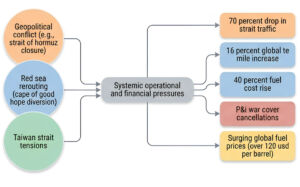
The primary driver of this systemic volatility is the de facto closure of the Strait of Hormuz, the world’s most critical hydrocarbon chokepoint, which handles approximately 20 percent of global petroleum liquids and liquefied natural gas (LNG) trade. Following air strikes by the United States and Israel on Iranian targets on February 28, 2026, and the subsequent assassination of Iran’s supreme leader, the waterway became an active zone of conflict. Between April 13 and May 29, 2026, the United States conducted a naval blockade of Iranian ports, prompting the Iranian Revolutionary Guard Corps (IRGC) to declare the strait closed and issue warnings that unauthorized vessels would be set ablaze.
This conflict has resulted in several commercial vessels being struck by drones, missiles, and projectile weapons. Notable incidents include the projectile strike on the oil tanker Skylight north of Khasab, Oman, which killed two Indian crew members, and a drone boat attack on the MKD VYOM that caused a fatal engine room explosion. Further attacks occurred at the port of Bahrain, where the US-flagged Stena Imperative was struck twice, and in the strait itself, where the Iranian-linked Athe Nova was targeted by IRGC drones.
The economic shockwaves of these diversions are felt most acutely in the insurance and energy markets. These hostilities prompted major Protection and Indemnity (P&I) Clubs, including Gard, Skuld, NorthStandard, the London P&I Club, and the American Club, to issue cancellation notices for war-risk cover for non-mutual fixed-premium entries starting March 5, 2026.
Consequently, war-risk premiums jumped from 0.2 percent to as high as 1 percent of hull value within 48 hours. For a modern vessel valued at 100 million USD, this adds up to 1 million USD in operational costs for a single transit, making direct routes economically unviable, causing a 70 percent drop in tanker traffic, and leaving over 150 ships anchored outside the strait. Global fuel prices responded by surging from 60 USD per barrel to over 120 USD per barrel, triggering the largest energy trade disruption since the 1970s.
These extended transit times have forced major ocean carriers to introduce emergency bunker surcharges and transit disruption surcharges to offset rising costs. Additionally, the strain on vessel schedules has led to a complete pause in landside bookings across critical transshipment hubs, leaving cargo stranded at inland terminals and creating localized equipment bottlenecks.
Outside the main East-West trade lanes, other maritime corridors are facing mounting regulatory and operational pressures:
- The Strait of Malacca: Carrying 45 percent of global seaborne oil and 23 percent of dry bulk agricultural cargo, this corridor is highly vulnerable to regulatory disputes and naval interceptions. Any prolonged delay here instantly disrupts supply chains across East Asia.
- The Panama Canal: While water levels have stabilized and the Panama Canal Authority has modernized slot planning through its LoTSA 2.0 long-term slot allocation program, geopolitical competition over canal infrastructure introduces constant volatility into US-bound routing decisions.
- Flag state regulations: The US Federal Maritime Commission (FMC) is increasing its scrutiny of flag state competition and maritime security compliance. Expected regulatory changes will limit flagging options and reduce vessel redeployment flexibility, raising compliance costs for operators in the Western Hemisphere.
Laytime economics, demurrage leakage, and legal risk
When the MV Triton finally completes its long detour around Africa and arrives in Northern Europe, its operational challenges do not end. Instead, they shift from the open ocean to the quayside. Because of upstream delays and schedule disruptions, dozens of container ships are now arriving at European ports simultaneously. This phenomenon, known as vessel bunching, completely overwhelms port terminals.
As the MV Triton joins a long queue of vessels waiting at the offshore anchorage outside Rotterdam, a complex legal and financial clock begins to tick. This is the domain of laytime, demurrage, and legal risk allocation.
Laytime is the contractually agreed duration allowed for loading or discharging cargo, governed by precise legal parameters. If the operations exceed this allowed window, the charterer faces severe financial penalties known as demurrage. If the operations are completed ahead of schedule, the charterer may receive a reward known as despatch.
The mathematical relationships governing these financial outcomes are precise:
Laytime overage (days) = (T_used – T_allowed) / 24
Demurrage liability (USD) = Laytime overage (days) * R_demurrage
In these equations, T_used represents the actual hours spent in cargo operations, adjusted for contractual interruptions, while T_allowed is the contractually permitted laytime, and R_demurrage is the daily demurrage rate specified in the charterparty. Under the strict legal doctrine where demurrage runs continuously once triggered, once the laytime clock expires, demurrage runs without pause. It is not paused by subsequent port closures, bad weather, or labor strikes unless explicitly carved out in the charterparty.
For the MV Triton, the immediate legal battleground is the validity of the Notice of Readiness (NOR). This is the master’s formal declaration that the vessel has arrived at the designated port and is physically and legally prepared to begin cargo operations.
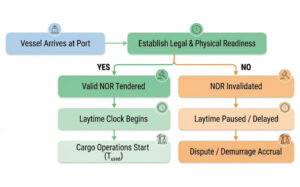
Landmark legal precedents dictate that both physical and legal readiness must be established before an NOR can be validly tendered:
- The physical standard: In the Tres Flores case, the court ruled that physical readiness requires the vessel’s holds and cargo gear to be fully prepared and free of contaminants before laytime can begin. If a vessel arrives but its holds require unexpected cleaning or pest fumigation, the NOR is invalid.
- The legal standard: In the Mexico I case, the court established that legal readiness requires the vessel to have obtained all necessary clearances, such as customs approval and free pratique (sanitary clearance). A premature or invalid NOR does not automatically become valid when the ship eventually reaches readiness; a new NOR must be tendered, or the parties must agree on when laytime begins.
In the current maritime environment, GPS jamming, sudden security inspections, and administrative delays frequently invalidate tendered NORs. If the MV Triton’s master tenders an NOR while the vessel is still waiting at the outer anchorage, and the port authorities later suspend customs clearance due to a security alert, the charterer will argue that the NOR was invalid, pausing the laytime clock and shifting the cost of the delay back to the shipowner.
The financial risk is heavily influenced by the chosen laytime calculation method:
Running days
Under this method, the laytime clock runs on a continuous 24-hour basis, including weekends and holidays without exception. This approach shifts almost all risk of timing delays to the charterer. If a port experiences a security lockdown or an administrative suspension over a weekend, the laytime clock continues to tick, leading to a rapid accrual of demurrage at full contractual rates.
Working days
This method excludes recognized local holidays, Sundays, or rest days from the laytime calculation. The operational risk is shared between the owner and the charterer. If the port suspends operations due to an administrative holiday, the laytime clock pauses. However, this method introduces significant administrative friction, as the parties must constantly cross-reference the official local port calendar to resolve disputes.
Weather working days
This approach suspends the laytime clock if weather conditions make cargo operations unsafe or physically impossible. While this protects the charterer from environmental delays, it introduces high potential for disputes. If military activity or security alerts prevent cargo operations, charterers often try to claim these as force majeure or weather exclusions, leading to intense legal debates over whether security-related port closures can be categorized under environmental exceptions.
The impending structural hangover: overcapacity, rate collapse, and the bullwhip whiplash
As the crew of the MV Triton faces delays at the quayside, shipowners and port managers must brace for a significant structural change on the horizon. The key long-term challenge confronting the maritime industry is not a lack of vessel capacity but rather a severe supply-demand imbalance.
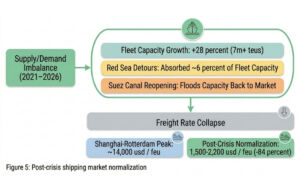
Fueled by record profits during the pandemic-era shipping boom, ocean carriers placed large orders for new vessels. From 2021 to 2026, the global fleet is set to expand by 28 percent in capacity, with over 800 new container ships being delivered, representing more than 7 million TEUs.
Although geopolitical disruptions in the Red Sea have persisted, this massive influx of capacity was temporarily masked. The longer routes around the Cape of Good Hope absorbed approximately 6 percent of global shipping capacity, keeping vessels active and preventing immediate layups. However, once regional tensions ease and the Suez Canal fully reopens, this absorbed capacity will flood back into the market.
This sudden influx of tonnage will coincide with a structural decline in consumer demand in Western economies. High inflation in services, shifting consumer spending habits, and sustainability initiatives have led to a decrease in the volume of physical goods imported into Europe and North America.
As a result, ocean freight rates are collapsing rapidly. Spot rates on major trade lanes, such as the Shanghai–Rotterdam route, have fallen by more than 84 percent, dropping from pandemic peaks of approximately 14,000 USD per FEU to between 1,500 USD and 2,200 USD per FEU. Similarly, rates on the Shanghai–Los Angeles route have plummeted by 85 percent, now ranging from around 1,200 to 1,800 USD per FEU.
To survive this downturn, major shipping lines are resorting to aggressive cost-cutting, network consolidation, and layoffs. For example, Maersk has cut 1,000 corporate positions, representing 17 percent of its workforce, to save 180 million USD in overhead costs. Other global carriers are also reporting significant margin contractions, with COSCO down 64 percent, HMM down 83 percent, and ONE down 86 percent.
The destructive bullwhip effect further amplifies this structural oversupply. This supply chain phenomenon occurs when minor fluctuations in end-consumer retail demand are progressively amplified as orders move upstream toward manufacturers and shipping lines.
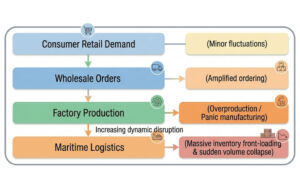
During the height of the geopolitical disruptions, retail shippers front-loaded their inventories, panic-ordered goods, and built up massive safety stocks to guard against transit delays. When shipping routes normalize and transit times shorten, this artificial demand will disappear.
Retailers, finding themselves holding overstocked warehouses, will halt new orders. This drop in volume will travel upstream, resulting in a prolonged period of near-zero cargo volumes for ocean carriers. Shipowners and port managers will face highly unpredictable demand cycles, shifting rapidly from peak port congestion to total underutilization of vessels, terminal yards, and labor.
Architectural preparedness: rebuilding the maritime tech stack
To build resilience against these volatile demand cycles and complex laytime environments, maritime operators must transition away from legacy, manual processes and adopt sophisticated digital architectures.
Recent crises have exposed the limitations of traditional, static planning tools. Shipowners require centralized, intelligent systems capable of dynamic route optimization, predictive fuel planning, and real-time safety monitoring.
Centralized AI fleet management systems (FMS)
Instead of relying on historical averages, modern Fleet Management Systems (FMS) process real-time telemetry, weather patterns, and port queue dynamics to adjust vessel speeds. This capability allows operators to bypass vessel bunching, minimize idle time at offshore anchorages, and avoid expensive demurrage charges.
By compressing reaction times, centralized AI FMS enables operators to detect early disruption signals and re-route vessels before bottlenecks become financially damaging. Modern implementations of these systems have demonstrated the ability to optimize fuel consumption under volatile conditions, improve vessel safety in areas experiencing GPS interference, and maintain high operational uptime.
The critical failure of generic generative AI in maritime logistics
A common mistake currently being made across the industry is the deployment of generic, probabilistic generative AI models to manage high-stakes regulatory and contractual workflows. While large language models (LLMs) excel at creative tasks, writing assistance, and natural language generation, they are structurally unsuited for laytime calculations and contract auditing.
Generic generative AI is fundamentally probabilistic. It predicts the most likely next word or token based on statistical patterns, rather than executing strict, deterministic rules. This operational model introduces the risk of hallucinations—where the AI confidently asserts false facts, wrong dates, or incorrect numerical values.
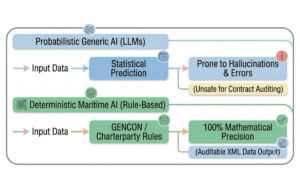
In maritime logistics, where a single misplaced decimal point in a Bill of Lading, Statement of Facts (SOF), or Notice of Readiness (NOR) can halt a vessel, generic AI errors can lead to millions of dollars in unnecessary demurrage charges and legal disputes.
Laytime calculations require deterministic precision. Every calculation must be executed against strict, unambiguous business rules defined in standard charterparties, such as GENCON clauses. The system must distinguish precisely between running days, working days, and weather working days, while cross-referencing daily port logs, weather reports, and local port customs. This level of accuracy can only be achieved through domain-specific, rule-based AI systems that combine advanced natural language processing with hard-coded mathematical and legal validation logic.
Intelligent document processing (IDP) and legacy system modernization
The operational efficiency of both shipowners and port managers is severely degraded by the human-bridge expense. Logistics coordinators still spend up to 60 percent of their time manually extracting, verifying, and syncing data across disconnected software platforms, legacy databases, and unstructured documents. This manual data entry is a massive financial drain and a primary source of downstream errors.
To solve this, operators must adopt intelligent document processing (IDP) engines built specifically for the maritime domain. Rather than building expensive custom development teams, logistics providers can partner with experienced systems integrators like Clavis Technologies.
Clavis Technologies offers specialized engineering services to bridge the gap between fragmented carrier data and internal logistics databases. By deploying an AI-native document intelligence engine, Clavis helps maritime operators move beyond basic optical character recognition (OCR) and securely transform unstructured paperwork into clean, structured digital assets.
These custom-engineered engines understand the deep domain context of maritime documents, allowing them to surgically extract fields from highly unstructured formats, such as handwritten port logs, complex Bills of Lading, and diverse Statement of Facts sheets, with over 99 percent precision.
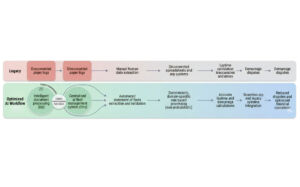
Furthermore, these systems integrate real-time validation loops. Once a document is processed, the system automatically converts the extracted data into structured, immutable formats like XML, creating clear audit trails. It then cross-checks the data against global maritime regulations, local port customs, and active charterparty terms before piping the structured assets directly into the company’s central Enterprise Resource Planning (ERP) or legacy voyage management system. Clavis Technologies specializes in this type of legacy modernization, helping organizations revitalize rigid, paper-based workflows without disrupting active operational setups.
Agentic workflow orchestration
The final layer of technological preparedness is agentic workflow orchestration. This approach replaces standard if-then triggers with autonomous AI agents capable of mapping complex decision-making trees, routing tasks, and resolving operational exceptions without requiring constant human prompts.
Through Clavis Technologies’ custom AI agent orchestration and integration services, operators can build intelligent multi-agent systems that think and act for their logistics teams. For example, when the document intelligence engine flags a discrepancy between a vessel’s Statement of Facts and the contractually allowed laytime, the orchestrator automatically:
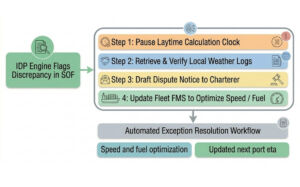
- Pauses the laytime calculation clock.
- Pulls local meteorological data to verify if a weather exception applies.
- Drafts a formal dispute notification to the charterer or port manager.
- Updates the vessel’s centralized AI Fleet Management System to adjust the voyage schedule and speed of the next voyage.
By automating these processes, the logistics team transitions from manually connecting fragmented systems to serving as high-level strategists overseeing an automated, high-velocity digital engine designed and integrated by a reliable technology partner.
Strategic roadmap: concrete actions for ship and port owners
The deep disruptions of 2026 demand a complete rethinking of maritime operations. The era of managing fleets via static historical averages and manual laytime calculations is over. The immediate operational reality is defined by acute geopolitical volatility, while the post-crisis horizon presents a challenging landscape of massive vessel overcapacity, collapsing freight rates, and bullwhip-driven demand swings.
To build long-term resilience, shipowners and port managers must execute clear, actionable strategies across their operations.
Actionable strategies for shipowners
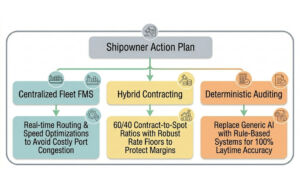
Establish centralized, dynamic fleet management
Shipowners must transition away from legacy scheduling processes and adopt AI-driven FMS platforms that optimize routes and speeds in real time. This is critical for navigating volatile choke points safely, avoiding localized port congestion, and reducing fuel consumption.
Implement deterministic, domain-specific contract auditing
To protect operating margins, owners must reject generic, probabilistic generative AI tools. Instead, they should invest in rule-based, deterministic AI architectures that parse contract clauses and calculate laytime with absolute mathematical and legal precision.
Transition to hybrid contracting
To guard against post-crisis rate collapses, owners should secure multi-year contracts with robust rate floors while maintaining a flexible 60/40 or 70/30 contract-to-spot ratio. This protects core revenue while allowing them to capitalize on sudden spot market spikes.
Actionable strategies for port managers
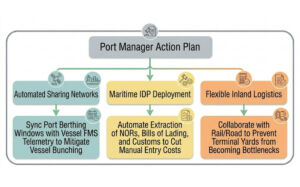
Build automated information-sharing networks
Port authorities and terminal operators must integrate their systems with arriving vessels’ FMS. By utilizing real-time ETA telemetry rather than static schedules, ports can dynamically adjust berthing windows, crane allocations, and labor shifts, directly reducing vessel bunching and dock congestion.
Eliminate manual data silos via maritime IDP
Ports must adopt domain-specific intelligent document processing systems. Working with an experienced transformation partner like Clavis Technologies allows ports to automate the extraction and validation of Bills of Lading, NORs, and customs documentation, eliminating the manual human-bridge expense and accelerating cargo throughput.
Develop flexible inland logistics networks
Recognizing that port bottlenecks often stem from inland constraints, port managers should establish dynamic, automated coordination loops with road, rail, and barge operators, ensuring terminal yards do not become long-term storage bottlenecks during demand spikes.
Conclusion: the algorithmic imperative
The maritime industry has always been characterized by its ability to navigate physical storms. However, the challenges of 2026 require a new method of navigation, one that operates in the digital realm. The winners of the upcoming decade will not be those with the largest fleets or the most historic ports, but rather those who can process data with the greatest speed and accuracy.
By replacing manual, probabilistic workflows with deterministic, domain-specific digital architectures, shipowners and port managers can turn volatility into a competitive advantage. Collaborating with technical experts like Clavis Technologies to modernize outdated systems and implement AI-driven workflows ensures that the journey of the MV Triton, along with thousands of vessels like it, does not have to involve compounding delays and unexpected costs. With the right technology stack, it can become a model of operational efficiency and algorithmic resilience.
