


Executive insight
Artificial intelligence has never been more accessible.
Enterprise leaders now have access to powerful foundation models, mature AI platforms, and an expanding ecosystem of agentic AI solutions capable of automating tasks, generating insights, and orchestrating workflows.
Yet despite growing investments, many organizations remain stuck in pilot mode, struggling to translate AI ambition into measurable business outcomes.
The common assumption is that AI initiatives fail because the technology is immature.
The evidence suggests otherwise. Organizations pursuing AI adoption and deployment should pay close attention to a growing trend emerging across enterprise transformation programs.
While AI capabilities continue to improve, many initiatives fail to progress beyond pilot environments because organizations discover operational, governance, and contextual challenges far too late in the transformation journey.
Recent industry research points to a different challenge: organizations are increasingly encountering issues related to governance, operational readiness, unclear business value, fragmented data, and escalating implementation costs as they attempt to scale AI initiatives.
Gartner predicts that more than 40% of agentic AI initiatives may be canceled by 2027 due to escalating costs, unclear business value, and inadequate controls.¹
The question leaders should ask is not why AI projects fail.
The more important question is why these risks are being discovered so late.
The answer lies in a critical but often overlooked phase of transformation: discovery.
Traditional discovery methodologies were designed for software implementations and process automation projects. They were never intended to evaluate autonomous systems capable of reasoning, making decisions, interacting across applications, and operating with varying levels of independence.
As organizations move from AI assistants to agentic systems, the gap between traditional discovery and AI readiness is becoming impossible to ignore.
This is the enterprise discovery crisis nobody is solving.
“AI is not failing because models are immature. AI is failing because enterprises are using yesterday’s discovery methods to design tomorrow’s autonomous systems.”
The dangerous misconception shaping AI investments
Many organizations continue to approach AI transformation as a technology procurement exercise.
The process typically follows a familiar pattern:
- Identify an AI use case
- Select a platform or model
- Connect enterprise data
- Launch a pilot
- Measure outcomes
While this approach may work for traditional software deployments, it often falls short when applied to AI.
Unlike conventional applications, AI systems operate within complex business environments shaped by context, judgment, exceptions, and human decision-making. They do not simply execute predefined instructions. They interact with information, interpret objectives, and increasingly influence how work gets done.
This distinction fundamentally changes what discovery must accomplish.
According to McKinsey’s latest State of AI research, organizations achieving the highest returns focus on workflow redesign and operating model transformation rather than isolated technology deployment.²
When organizations treat AI as a software upgrade, they often focus on narrow technical requirements while overlooking the operational realities that determine whether AI can scale successfully.
The result is not transformation. It is experimentation without a roadmap.
Why the rise of agentic AI is exposing discovery failures
One of the most significant shifts in enterprise AI over the past year has been the move from single-purpose assistants to agentic systems capable of coordinating tasks, accessing multiple systems, and making contextual decisions. This evolution is creating a new challenge for organizations.
Traditional discovery frameworks are designed to answer questions such as:
- What process needs improvement?
- Which systems are involved?
- What inputs and outputs are required?
Agentic AI introduces an entirely different set of questions:
- How are decisions actually made?
- Where does critical business knowledge reside?
- What contextual information influences outcomes?
- Which decisions require human oversight?
- What are the consequences of incorrect actions?
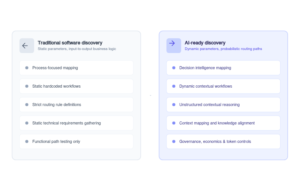
Most organizations have never mapped these dimensions. As a result, they enter implementation with a clear understanding of workflows but very little understanding of the decision systems that drive those workflows.
This gap becomes increasingly visible as AI initiatives move beyond experimentation and into production environments.
The hidden discovery failures leaders rarely see
The challenges most frequently associated with AI adoption—data quality, governance, and change management—are often symptoms of deeper discovery failures. The real issues emerge much earlier.
Organizations map processes but ignore decisions
Traditional discovery excels at documenting workflows. It struggles to capture how decisions are made.
Consider a procurement approval process. A process map may show a sequence of steps moving from request submission to manager approval and procurement review.
What it rarely captures is why approvals are granted, how exceptions are handled, which risks influence decisions, and what institutional knowledge experienced employees apply during evaluation.
AI systems must operate within these decision layers.
If discovery fails to identify them, implementation teams are forced to make assumptions that can introduce operational risk.
Context debt is becoming a business liability
Every organization accumulates what can be described as context debt.
Critical business knowledge exists across emails, meetings, shared documents, customer interactions, and employee experience. Much of it is undocumented and inaccessible through traditional systems. Stanford’s AI Index highlights that enterprise adoption continues to accelerate, yet scaling AI into production remains a significant challenge for many organizations.³
This scale constraint often traces directly back to context debt. For years, organizations have been able to operate despite this fragmentation because employees bridge these gaps through collaboration and experience.
AI systems cannot. When agentic systems encounter incomplete context, performance suffers. Recommendations become unreliable, automation breaks down, and trust erodes.
Addressing context debt often requires organizations to modernize fragmented data environments and create unified information access layers. This is why many enterprises are investing in data modernization initiatives before scaling AI-driven workflows.
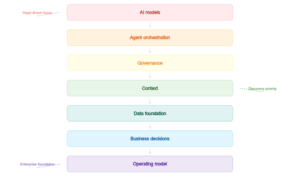
“Organizations don’t have a data problem. They often have a context problem.”
The focus remains on automation instead of autonomy
A significant number of AI initiatives still focus on automating individual tasks.
While task automation can generate incremental efficiency gains, it rarely delivers transformational value. Deloitte’s State of Generative AI research found that governance, risk management, and data readiness remain among the most significant barriers to enterprise-scale implementation.⁴
Agentic AI introduces a different opportunity: redesigning how work is performed across entire operational ecosystems.
This requires organizations to think beyond individual activities and evaluate how decisions, information, and responsibilities flow through the business.
Without this broader perspective, AI becomes another productivity tool rather than a strategic capability.
Organizations looking to operationalize agentic AI frequently discover that their existing workflows lack the orchestration required to support autonomous decision-making. This is where process orchestration and business process automation become foundational capabilities.
AI economics are rarely considered during discovery
One of the least discussed challenges in enterprise AI is economic sustainability.
Organizations often assess technical feasibility and expected productivity gains but fail to evaluate the long-term economics of AI operations.
Key questions are frequently overlooked:
- What will AI operating costs look like at scale?
- How much human review will remain necessary?
- What governance overhead will be required?
- How will costs evolve as usage grows?
These factors can significantly influence ROI. Yet they are rarely addressed during discovery, when they can be most effectively managed.
Why traditional discovery approaches are no longer enough
Traditional discovery methodologies were developed for deterministic systems.
They assume that business processes are largely predictable, outcomes are consistent, and rules are well-defined.
AI challenges these assumptions. Modern AI systems operate within environments shaped by uncertainty, contextual variation, and human judgment.
This requires a different approach to discovery.
Organizations must move beyond process mapping and develop a more comprehensive understanding of how their business actually functions.
At Clavis Tech, we believe effective AI discovery should evaluate five interconnected dimensions:
| Traditional discovery focus | AI-ready discovery focus |
| Process mapping | Decision mapping |
| System inventory | Context inventory |
| Requirements gathering | Knowledge-flow analysis |
| Automation opportunities | Autonomy opportunities |
| Technical feasibility | Economic and governance readiness |
This broader perspective helps organizations identify hidden risks before implementation begins.
More importantly, it creates a foundation for sustainable AI adoption.
“Traditional discovery maps workflows. AI discovery must map decisions, context, governance, and economics.”
A blueprint for modern AI discovery
As AI becomes increasingly embedded within enterprise operations, discovery must evolve from a requirements-gathering exercise into a business intelligence discipline.
Organizations should focus on five key areas.
Operational intelligence mapping
Understand how work flows across departments, systems, and teams.
Decision intelligence mapping
Identify how decisions are made, who owns them, and where judgment is applied.
Context readiness assessment
Evaluate the accessibility, quality, ownership, and completeness of organizational knowledge.
Governance and human oversight design
Define where human involvement remains necessary and how risk will be managed.
Economic viability modeling
Assess long-term operating costs, scalability considerations, and expected business value.
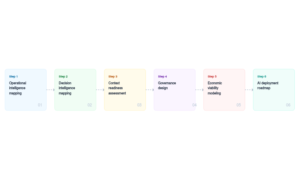 Together, these activities provide a more accurate view of AI readiness and reduce the likelihood of costly surprises during implementation.
The strategic opportunity for business leaders
The organizations succeeding with AI are not necessarily deploying the largest models or investing the most capital.
They are building a deeper understanding of their own operations. They know where decisions are made. They understand how knowledge moves through the organization.
They recognize where context gaps exist. And they address these challenges before implementation begins. This is where organizations gain a sustainable advantage.
As argued in Harvard Business Review, building AI transformations that deliver value requires aligning pilot programs to deep structural discoveries.⁵ True strategic acceleration is an opportunity to redesign how work, decisions, and intelligence flow across the enterprise.
That transformation starts long before deployment. It begins with discovery.
The path forward
The conversation around AI often focuses on models, platforms, and emerging capabilities.
These factors matter. But they are no longer the primary barrier to success.
The next generation of AI leaders will not be defined by the sophistication of the technology they purchase. They will be defined by how well they understand the operational environments those technologies must navigate.
PwC warns in their recent industry projections that scaling AI without robust structural discovery often yields fragile solutions that degrade over time.⁶ In the era of agentic AI, the biggest challenge is not building intelligent systems.
It is building organizations that are ready for them.
And that is why the most important AI transformation work happens before implementation ever begins.
References:
¹ Gartner. (2025). Gartner Predicts Over 40% of Agentic AI Projects Will Be Canceled by End of 2027. Gartner Press Release. https://www.gartner.com
² McKinsey & Company. (2025). The State of AI 2025. McKinsey Technology Council. https://www.mckinsey.com
³ Stanford Institute for Human-Centered AI (HAI). (2025). AI Index Report 2025. Stanford HAI Publications. https://hai.stanford.edu/ai-index-2025
⁴ Deloitte. (2025). State of Generative AI in the Enterprise 2025. Deloitte Insights. https://www.deloitte.com
⁵ Harvard Business Review. (2025). Building AI Transformations That Deliver Value. Harvard Business School Publishing. https://hbr.org
⁶ PwC. (2025). 2025 AI Business Predictions. PwC Intelligence. https://www.pwc.com
