

The modern enterprise operating model is experiencing a silent fragmentation. For over a decade, Robotic Process Automation (RPA) handled structured, repetitive tasks. Over the last two years, generative AI and autonomous agentic workflows have introduced cognitive capabilities capable of handling unstructured data, generating content, and making real-time decisions. Yet, despite these technological leaps, the most valuable asset remains human judgment.
The challenge facing today’s technology leaders is no longer about deploying a single bot or testing an isolated LLM. The challenge is coordination.
Without a unified orchestration framework, enterprises build modern silos: RPA bots that break when a UI changes, isolated AI agents that run up high token costs without delivering business outcomes, and human teams constantly context-switching to bridge the gaps.
To achieve true operational maturity, organizations must transition from siloed automation to a structured, tri-part architecture that seamlessly coordinates human expertise, agentic AI, and deterministic bots.
Understanding the three pillars of the hybrid enterprise workforce
To orchestrate a hybrid workforce, enterprise architects must first understand the fundamental differences in execution patterns, decision-making capabilities, and failure modes across humans, AI agents, and deterministic bots.
Designing a resilient architecture requires placing each entity where its operational profile delivers the highest yield.
| Operational attribute | Deterministic bots (RPA) | Cognitive AI agents (LLM Orchestrated) | Human professionals |
| Execution pattern | Rule-based, structured, linear, and highly repetitive. | Dynamic, goal-oriented, non-linear, and adaptive. | Creative, critical, contextual, and highly strategic. |
| Data interaction | Structured data (APIs, databases, strict UI elements). | Unstructured data (natural language, emails, complex PDFs). | High-ambiguity, emotional, qualitative, and ethical inputs. |
| Decision-making | Binary logic gates (If/Then/Else). | Probabilistic reasoning, semantic synthesis, planning. | Heuristic judgment, strategic alignment, empathetic evaluation. |
| Primary failure mode | Brittle execution when system schemas or UI elements change. | Hallucination, token drift, planning loop errors. | Fatigue, administrative bottlenecking, scaling limitations. |
| Ideal operational role | High-speed data entry, systems sync, structured migrations. | Synthesis, draft generation, initial triage, data transformation. | Exception handling, strategic oversight, final sign-off, client relations. |
A common failure point in modern enterprise architecture is trying to make one pillar act like another. For example, using expensive LLM calls to parse highly structured CSV data is economically inefficient and architecturally unsound; a lightweight script or RPA bot is far better suited.
Conversely, attempting to write thousands of rigid regex rules in an RPA tool to analyze customer sentiment is bound to fail; this is where cognitive AI agents thrive.
Why linear automation fails in the age of agentic AI
Traditional workflow automation models are built on directed acyclic graphs (DAGs) and rigid step-by-step logic. While this works beautifully for invoicing or payroll syncing, it breaks down when introduced to the fluid, open-ended capabilities of generative AI.
According to a 2025 McKinsey & Company analysis on enterprise AI deployment, organizations that rely solely on legacy, deterministic automation pipelines fail to capture up to 60% of the cognitive value that generative agents can offer [^1]. Legacy pipelines force agents into rigid parameters, treating an LLM like a database query rather than a dynamic reasoning engine.
When cognitive agents are forced into rigid, linear constraints, two main problems arise:
- The context window wall: Agents cannot maintain the state or historical context of a multi-day, multi-stakeholder business process, leading to disconnected and irrelevant actions.
- The infinite loop trap: Autonomous agents left to solve open-ended goals without clear human-in-the-loop (HITL) checkpoints can fall into circular loops, continuously calling APIs and consuming tokens without reaching a resolution.
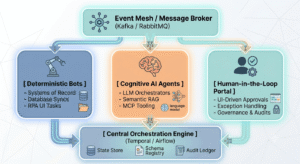
Effective enterprise workflow orchestration requires a stateful, event-driven orchestration layer. This layer must treat LLMs, RPA bots, and humans as peer nodes in a dynamic network. Instead of hardcoded steps, the workflow engine manages state transition, tracks token spend, handles errors gracefully, and routes exceptions to human operators when confidence scores fall below threshold limits.
Architectural patterns for scaling human-AI-bot orchestration
Designing a reliable, enterprise-scale orchestration engine requires moving beyond basic API integrations. To build a robust system, engineering teams should implement a modular, event-driven pattern that separates execution, reasoning, and governance.
State management and session persistence
Because enterprise workflows can span days or weeks—such as loan underwriting, complex claims processing, or compliance audits—the orchestration engine must maintain state independently of the executing agents.
Using lightweight, distributed workflow engines like Temporal or event-driven backbones like Apache Kafka allows the system to persist state across asynchronous boundaries. If an AI agent generates a draft and pauses for human approval, the workflow state is saved, ensuring that when the human responds forty-eight hours later, the context remains perfectly intact.
Human-in-the-loop (HITL) gatekeeping and guardrails
To mitigate LLM hallucinations and system failures, the architecture must implement deterministic guardrails. This includes establishing strict threshold limits:
- Confidence scoring: Every output generated by an AI agent must be evaluated by an automated validation layer. If the confidence score drops below a pre-configured threshold (e.g., 85%), the workflow suspends execution and generates a human-in-the-loop task.
- Token & budgets: Implementing strict rate-limiting and budget allocations per process instance to prevent runaway agentic loops from inflating cloud costs.
- Semantic guardrails: Utilizing tools like NeMo Guardrails to sanitize inputs and outputs, ensuring agents never process unsanctioned system commands or violate regulatory compliance guidelines.
The Model Context Protocol (MCP) and orchestration layers
A major advancement in scaling agent-to-bot communication is the Model Context Protocol (MCP). Developed as an open standard, MCP allows developers to build secure, standardized bilateral connections between LLM applications and external data sources or tools.
By utilizing MCP, an enterprise AI agent can query databases, call legacy mainframe APIs via an RPA bridge, or trigger a human notification via Slack or Teams using a uniform protocol. This significantly reduces the custom integration code required to connect legacy enterprise systems with cognitive models.
Designing for the future of collaborative intelligence
As agentic workflows become more autonomous, the human role in enterprise operations will shift from executors of routine processes to orchestrators and auditors of intelligent networks.
Organizations that invest today in building a unified orchestration layer—combining the speed of RPA, the cognitive agility of AI, and the irreplaceable strategic reasoning of humans—will build a resilient, scalable, and highly adaptable operation.
Strategic next steps for enterprise leaders
Organizations looking to move beyond basic automation silos must systematically prepare their architecture for multi-agent and human coordination:
- Evaluate your current integration maturity: Determine whether your current RPA and API integrations can handle asynchronous, non-linear agentic workflows.
- Decouple orchestration from execution: Avoid hardcoding agent logic directly into business applications; instead, utilize a dedicated orchestration engine to coordinate systems, agents, and human touchpoints.
- Prioritize a security and governance framework: Establish robust Human-in-the-Loop guardrails, state-persistence logs, and data-privacy boundaries.
Organizations exploring AI-first product engineering or intelligent workflow modernization should evaluate whether their existing architecture can support state management, memory, and agent-driven workflows at scale.
To explore how your organization can design and build a secure, high-throughput orchestration framework, explore the Clavis Tech Business Process Orchestration services and partner with our engineering teams to accelerate your digital transformation.
Frequently asked questions (FAQs)
What is the difference between RPA and agentic AI?
RPA (Robotic Process Automation) is deterministic, executing pre-defined, rule-based tasks with structured data. Agentic AI is probabilistic, using large language models to reason, plan, use tools, and make dynamic decisions based on unstructured inputs. RPA handles the “muscles” of an operation, while agentic AI handles the “brain.”
How do you handle human-in-the-loop (HITL) without creating operational bottlenecks?
To prevent HITL from slowing down workflows, enterprises must implement asynchronous state management, set clear notification routing rules, and design progressive task-escalation protocols. Additionally, by setting automated confidence-score thresholds, only high-ambiguity exceptions are routed to humans, while low-risk, high-confidence actions run completely automatically.
What is the Model Context Protocol (MCP) in enterprise AI?
The Model Context Protocol (MCP) is an open standard that enables secure, bilateral communication between LLMs and external tools, databases, or systems. It provides a standardized API contract, making it much easier to connect AI agents with legacy software systems, RPA interfaces, and enterprise databases without writing fragile, custom integrations for every tool.
How do we prevent autonomous AI agents from creating infinite execution loops?
Enterprises can prevent infinite loops by implementing strict execution guardrails within the orchestration engine. This includes setting hard limits on maximum consecutive agent actions (e.g., maximum 5 tool calls per task), implementing real-time token spend trackers, and using deterministic circuit breakers that pause the process and notify a human auditor if anomalous behavior is detected.
Is it necessary to replace legacy RPA tools to adopt agentic workflows?
No. Replacing legacy RPA is not necessary and often counterproductive. The most effective strategy is to use RPA as “tools” or “execution nodes” that cognitive AI agents can invoke when they need to interact with legacy applications that lack APIs. This leverages your existing RPA investments while enhancing them with cognitive decision-making.
Footnotes
[^1]: McKinsey & Company. (2025). The state of AI in 2025: Generative AI adoption and operating model maturity. McKinsey Digital. https://www.mckinsey.com/capabilities/mckinsey-digital/our-insights
[^2]: Gartner, Inc. (2025). Top Strategic Technology Trends for 2025: Agentic AI. Gartner Research. https://www.gartner.com/en/information-technology/insights/top-technology-trends
[^3]: Harvard Business Review. (2024). Collaborative Intelligence: Humans and AI Joining Forces. HBR Press. https://hbr.org/2018/07/collaborative-intelligence-humans-and-ai-joining-forces
[^4]: Deloitte Consulting. (2025). Tech Trends 2025: The Co-evolution of Humans and Machine Intelligence. Deloitte Insights. https://www2.deloitte.com/us/en/insights/focus/tech-trends.html
