

When enterprise organizations trade structural integrity for engineering speed, they borrow against their future capability. This strategic tradeoff is the foundation of technical debt. While taking shortcuts can help launch a feature quickly, the compounding interest of poorly integrated, outdated software eventually slows innovation to a crawl. For modern enterprises, the battle of technical debt vs business growth is one of the single greatest operational challenges of the decade.
To put this in perspective, technical debt refers to the accumulated cost and effort required to fix past technology compromises. When left unmanaged, legacy applications act as a silent tax on operations. Instead of funding new digital products, a massive portion of enterprise IT budgets is diverted just to keep these aging systems functional.
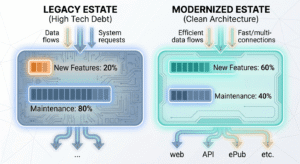
The gap between agile startups and legacy-bound enterprises is widening rapidly. Organizations must recognize that modernization is not merely a technical housekeeping chore; it is an absolute commercial necessity.
What is architectural technical debt and why does it compound?
Architectural technical debt represents the structural deficiencies in an enterprise application’s foundation that prevent scalability, flexibility, and integration. Unlike localized code debt, which might manifest as a poorly written script, architectural debt is systemic. It exists in rigid data schemas, monolithic structures, and outdated middleware that cannot support modern engineering patterns.
The scale of this issue is immense.
According to Deloitte’s 2026 Global Technology Leadership Study, technical debt now absorbs between 21% and 40% of total enterprise IT spending [1]. This means that for every dollar spent on IT, up to 40 cents is immediately lost to servicing legacy constraints rather than building new business value. Furthermore, Gartner reports that 80% of technical debt will be architectural in nature [2]. This makes structural debt the single most consequential technological bottleneck for enterprise leaders to resolve.
Like financial compound interest, architectural debt multiplies over time. When engineers build new features on top of a fragile, undocumented legacy system, they must write complex workarounds. Each workaround acts as a new layer of debt, requiring even more effort to bypass during future updates. This cycle degrades development velocity and increases the system’s overall fragility.
The quantifiable drag: How legacy applications block strategic growth
Legacy applications do not just cost money to maintain; they actively block strategic growth. When an IT department is trapped in reactive maintenance mode, engineering teams lose the capacity to experiment, build, and deploy new capabilities.
The contrast between organizations burdened by architectural technical debt and those operating on modernized estates is stark. McKinsey’s research reveals that companies with the lowest technical debt scores achieved revenue growth 20% higher than competitors burdened with high debt levels [3].
The structural differences between these two states highlight why legacy applications limit operational efficiency:
| Architectural metric | Legacy-heavy portfolio (high tech debt) | Modernized composable portfolio |
| Maintenance vs. innovation | 70% to 80% of budget spent on maintenance | Less than 40% of budget spent on maintenance |
| Average time-to-market | Months to quarters for minor updates | Days to weeks for major feature releases |
| Integration pattern | Brittle point-to-point connections, batch CSVs | Standardized APIs, event-driven architecture |
| AI readiness | Highly restricted; data trapped in silos | High; clean pipelines support Agentic workflows |
| Developer productivity | ~40% of weekly engineering time wasted on debt [4] | Dynamic pipeline; minimal maintenance friction |
When nearly 80% of your technology budget is allocated to operations and maintenance, your business is effectively standing still. Meanwhile, cloud-native competitors utilize microservices and composable frameworks to deploy software continuously, capturing market share in real time.
Decoding the hidden operational fees of maintaining legacy systems
Many organizations struggle to justify application modernization because the true costs of legacy estates are buried across various business units. To build a robust business case, leaders must look beyond basic hosting fees to identify the hidden operational expenses.
Talent premiums and developer burnout
Maintaining legacy software requires specialized, highly specific talent. As languages like COBOL, Fortran, or early versions of Java and .NET age out of mainstream education, finding engineers to maintain these systems becomes exceptionally expensive. HR departments must pay steep talent premiums for specialized legacy contractors.
At the same time, forcing modern engineering teams to work with ancient, undocumented systems leads to rapid burnout. Developers spend up to 42% of their workweeks dealing with technical debt and maintenance issues [4]. This lack of impact frustrates top tier talent, driving up recruitment and onboarding costs.
The integration tax and artificial intelligence barriers
Legacy applications were designed before the era of open APIs, cloud ecosystems, and AI orchestration. Consequently, connecting these platforms to modern customer-facing systems requires building complex custom middleware. This is known as the “integration tax.”
This tax becomes especially problematic for organizations aiming to adopt Generative AI. A study by Pegasystems notes that legacy systems actively obstruct AI adoption, leaving fragmented enterprises 30% more likely to experience implementation delays [5]. AI models and intelligent agents require clean, real-time data pipelines. If your data is locked in a legacy transactional database that only allows batch CSV exports once a night, your AI initiatives are blocked before they even begin.
To illustrate, Clavis Tech modernized Toyworld’s legacy retail architecture to enable real-time inventory synchronization. For Rajkamal Prakashan, Clavis Tech automated editorial production workflows, bypassing decades of publishing technical debt.
Strategic modernization: Navigating the technical debt recovery curve
Resolving architectural technical debt does not require a risky, rip-and-replace overhaul. In fact, Gartner reports that over 70% of legacy migration projects that rely heavily on automated AI translation without careful architectural planning end in failure [6].
Instead, enterprise leaders should adopt a structured, evolutionary approach to platform modernization.
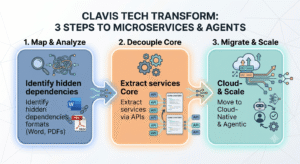
- Map and quantify the estate: Begin by mapping out legacy application dependencies and calculating your Technical Debt Ratio (TDR). This turns abstract complaints about “slow systems” into quantifiable business risks.
- Decouple core capabilities via APIs: Avoid major disruptions by wrapping legacy engines in modern API layers. This allows you to extract business rules and data without shutting down core systems.
- Modernize electronically (Strangler Fig Pattern): Gradually replace legacy components with microservices and serverless functions. Over time, the old system shrinks as the modern architecture grows to handle the workload.
- Adopt composable, AI-ready frameworks: Rebuild core pipelines to support real-time data exchange, preparing your application estate for intelligent agent orchestration and micro-frontend structures.
Next steps for enterprise leaders
Organizations exploring AI-first product engineering should evaluate whether their existing architecture can support orchestration, memory, and agent-driven workflows at scale.
If your teams are spending more time managing legacy issues than deploying new features, discover how Clavis Tech’s Legacy modernization & architectural maturity services can help you systematically reduce technical debt and accelerate business growth.
Frequently asked questions about technical debt
Is technical debt the same as legacy technology?
No, they are different. Legacy technology refers to software or hardware that is outdated but still functional. Technical debt, however, is the structural compromise made within systems (whether old or new) that causes development friction and increases maintenance costs over time. You can have brand-new code that still carries significant technical debt.
How do you measure the cost of technical debt?
You can measure technical debt using the Technical Debt Ratio (TDR), which compares the cost of fixing a system’s architectural issues against the cost of rebuilding it from scratch. Additionally, organizations track the Maintenance-to-Innovation Ratio, monitoring how much of their IT budget goes toward upkeep versus new feature development.
Why do AI modernization projects often fail?
Most AI and mainframe migration failures happen when organizations try to use generative AI tools to translate legacy code line-by-line without addressing the underlying architecture. Without organizing data pipelines and decoupling services, AI translation simply replicates old architectural flaws in a new language.
How much budget should be allocated to reducing technical debt?
Leading consulting firms recommend allocating 15% to 20% of the annual IT budget specifically for proactive debt reduction and refactoring. Making this consistent investment prevents systems from reaching a critical state where reactive emergency fixes consume up to 80% of development capacity.
Can technical debt impact enterprise compliance and security?
Yes, significantly. Legacy applications often lack support for modern security measures, such as multi-factor authentication (MFA) or real-time threat detection. This leaves systems vulnerable to data breaches and can result in regulatory penalties under frameworks like GDPR, HIPAA, or the GLBA Safeguards Rule.
Reclaiming your IT roadmap
Unaddressed technical debt acts as a drag on enterprise agility. When organizations allow outdated applications to dictate their development speed, they lose the ability to compete in a rapidly evolving market. Managing technical debt requires visibility, clear financial modeling, and a structured approach to modernizing legacy systems. By systematically addressing architectural debt, engineering teams can transition from simply maintaining old code to driving new business growth.
Footnotes
- Deloitte Consulting, “Global Technology Leadership Study 2026,” June 2026.
- Gartner Research, “Market Guide for Technical Debt Management Tools,” April 2026.
- McKinsey & Company, “What Is Technical Debt? A Strategic Guide for IT Leaders,” May 2026.
- Stripe, “The Developer Coefficient: Key Benchmarks on Software Engineering Capacity,” updated with 2025/2026 operational indicators.
- Pegasystems, “Enterprise Technology Debt and the Barriers to AI Integration,” 2025.
- Gartner, “Overestimating AI Threatens Legacy Mainframe Migrations,” June 2026.
- Clavis Tech Case Study Database: Pearson Workflow Automation Initiative.
- Clavis Tech Case Study Database: Manohar Filaments Intelligent Processing Optimization.
- Clavis Tech Case Study Database: Spirra Content Engineering Automation.
