

For modern enterprise leaders, technical debt is no longer just a backlog of developer tickets or a minor engineering inconvenience. It has evolved into a quiet but aggressive tax on business growth, restricting agility and draining financial resources.
As organization leaders scramble to integrate artificial intelligence, build agentic workflows, and achieve true operational efficiency, they quickly run into a wall of rigid, outdated code. True modernization is not about deploying the latest tools on top of fragile foundations; it is about systematically restructuring your architecture to support long-term, scalable innovation.
What is technical debt in modern enterprise IT?
Technical debt is the cumulative cost of choosing fast, temporary software workarounds today instead of building sustainable, scalable architectural solutions for tomorrow. Over time, these shortcuts accrue interest in the form of elevated maintenance costs, fragile systems, operational bottlenecks, and severe limits on feature velocity.
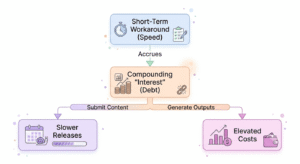
While early industry definitions focused mainly on messy code or missing documentation, modern enterprise technical debt is far more complex. According to Gartner, 80% of technical debt will be architectural in nature[^1]. This structural debt occurs when system components are tightly coupled, data models are outdated, and platforms cannot easily connect to modern APIs or cloud-native ecosystems.
When your underlying architecture is fundamentally rigid, even simple functional updates require massive, custom workarounds. This turns routine operations into expensive, high-risk development cycles.
How technical debt silently drains your innovation budget
The financial drag of technical debt is often hidden across multiple operational line items, making it difficult for finance teams to spot. Recent research from McKinsey reveals that technology debt consumes 40% to 50% of the entire IT investment budget for major organizations[^2].
This means that nearly half of every technology dollar spent is directed toward maintenance, workarounds, and “keeping the lights on,” rather than building new revenue-generating products.
This drag shows up in three distinct ways across the enterprise:
- The developer productivity drain: Engineers working on systems with high technical debt spend up to half of their time patching bugs, managing fragile integrations, and navigating poor documentation. Paying down this debt can free up development teams to spend up to 50% more of their active hours on valuable, customer-facing innovation[^2].
- Skyrocketing support costs: Legacy software maintenance is not a flat rate; it grows non-linearly. As system components age and specialized talent (such as legacy language experts) becomes rarer, contractor rates climb. Meanwhile, vendors charge premium rates for “extended support” tiers.
- Severe opportunity cost: In modern business, speed is a primary competitive advantage. When launching a new digital initiative requires weeks of manual data cleaning and complex integration fixes, the market window can close before the product ever launches. Modernized organizations typically experience 20% to 30% faster cycle times and significantly higher system reliability[^2].
The architectural bottleneck: Why 80% of tech debt blocks scale
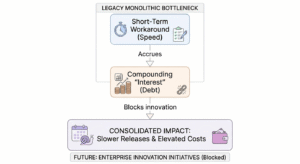
Many technology leaders mistakenly believe that migrating legacy software to the cloud will automatically solve their technical debt. However, a basic “lift-and-shift” migration simply moves outdated, inefficient software from local servers to cloud servers.
The core issues—such as hard-coded dependencies, monolithic architectures, and siloed databases—remain entirely unchanged. This approach often results in higher cloud consumption bills because poorly optimized legacy systems require excessive computing power to run.
To unlock modern enterprise capabilities like real-time data streaming and composable workflows, you must build on a highly modular foundation. Outdated, legacy systems act as a barrier to these advancements, making it nearly impossible to implement modern data-driven tools effectively.
The impact of AI-generated code on technical debt accumulation
The rise of artificial intelligence in software development has introduced a new challenge for managing technical debt. With more than half of software developers now utilizing generative AI and automated agents, code is being written at an unprecedented volume and speed[^3].
While these tools boost initial development output, they can easily bypass standard design patterns and quality reviews.
If this flood of automated code is not carefully governed and integrated, it can quickly lead to fragmented codebases and inconsistent architecture. This rapidly increases the long-term cost of maintaining your systems.
Bridging the gap: modernization frameworks that actually work
Successful legacy modernization requires moving away from reactive, temporary fixes and adopting a structured, business-aligned strategy. Enterprise leaders must evaluate and categorize their technical liabilities to make smart, targeted modernization investments.
Gartner recommends assessing and prioritizing technical debt across five key operational dimensions[^4]:
| Debt Dimension | Key business risk | Diagnostic question to ask |
| Maintainability | High ongoing support costs and slow development cycles. | How difficult and expensive is it to update or patch this system? |
| Compatibility | Siloed operations and manual data cleaning. | Can this application easily exchange data with modern, cloud-native systems? |
| Portability | High infrastructure costs and vendor lock-in. | Can we run this workload efficiently across public or hybrid clouds? |
| Security | Increased vulnerability to breaches and compliance issues. | Is this system using unsupported libraries or legacy protocols? |
| Performance | Operational bottlenecks and poor user experience. | Does this software slow down business workflows during peak demand? |
Deconstructing the risk: a clear roadmap to architectural health
Once you have categorized your technical debt, you can design a step-by-step modernization roadmap that delivers immediate, measurable value to the business:
- Locate the bottlenecks: Audit your tech stack to identify the legacy systems that cause the highest maintenance costs and the most developer friction.
- Align with business value: Prioritize modernization projects that directly support core business goals, such as improving speed-to-market or reducing operational overhead.
- Adopt a modular approach: Instead of attempting a risky, all-at-once system replacement, gradually break down your legacy monolith into modern microservices using APIs.
- Automate quality checks: Embed automated code testing and architectural reviews directly into your development pipelines to prevent new technical debt from building up.
How Clavis Tech helps organizations pay down architectural debt
Resolving complex, deep-seated technical debt requires specialized software engineering expertise and a deep understanding of modern architecture. At Clavis Tech, we partner with enterprises to turn fragile, outdated systems into scalable, high-performing digital assets that drive growth.
Our team specializes in helping businesses navigate complex modernization journeys:
- Legacy modernization & architectural maturity: We systematically restructure legacy applications into modern, microservices-based platforms, helping businesses significantly lower their technical debt and improve software release speeds.
- Business process orchestration: We design and implement smart, automated workflows that replace slow, manual workarounds with efficient digital processes.
- Strategic staff augmentation: We provide highly skilled engineering teams to help you accelerate legacy system transformations without disrupting your daily business operations.
Our approach is validated by real-world success across diverse industries. For example, a giant publishing organization, Pearson, significantly reduced manual production bottlenecks through workflow automation, enabling much faster content delivery.
In another case, Manohar Filaments transformed document-heavy operations by implementing intelligent extraction and validation workflows, reducing manual intervention and improving compliance.
Additionally, Spirra by Refuel agency built an AI-driven automation initiative to enable near real-time content generation while maintaining strict quality controls.
Turning technical debt into a growth advantage
Addressing technical debt is more than a technology initiative—it is a strategic investment in future growth. Legacy systems, fragmented architectures, and outdated processes can limit an organization’s ability to innovate, scale, and respond to changing market demands. By adopting a structured modernization approach, businesses can reduce operational complexity, free up valuable IT resources, and create a foundation for cloud integration, automation, and agile delivery.
Organizations should regularly assess their architectural maturity to determine whether their systems can support evolving business needs and digital transformation goals. With the right modernization roadmap and technology partner, enterprises can move beyond maintaining legacy platforms and transform their technology landscape into a driver of innovation, efficiency, and competitive advantage.
If you’re evaluating your modernization journey, Clavis Tech can help assess your current architecture, define a clear transformation strategy, and accelerate the transition to scalable, future-ready systems.
FAQ
What are the main signs that an enterprise has high technical debt?
The most common signs of high technical debt include slow software release cycles, high maintenance costs, frequent system bugs after simple updates, a heavy reliance on manual data entry, and an inability to easily integrate with modern, cloud-native applications.
Why is architectural technical debt harder to fix than code debt?
Code debt usually involves simple, localized issues like messy code or missing documentation, which can be quickly refactored. Architectural debt, however, is a structural issue involving tightly coupled system components and rigid data models. Resolving architectural debt requires strategic, high-level planning and systematic restructuring to avoid disrupting core business operations.
Can migrating to the cloud resolve legacy technical debt?
No. A simple “lift-and-shift” migration only moves your legacy software to a cloud environment. It does not address the underlying structural issues, such as monolithic codebases or rigid data silos. To truly resolve technical debt, you must modernize the application’s architecture to leverage cloud-native benefits.
How does technical debt impact artificial intelligence initiatives?
AI engines and automated workflows require clean, structured, and easily accessible data in real-time. Legacy systems with high technical debt often trap data in isolated silos, making it difficult or impossible to feed modern AI models with the reliable information they need to function.
How should business leaders prioritize which technical debt to pay down first?
Leaders should evaluate systems based on five key dimensions: maintainability, compatibility, portability, security, and performance. Priority should be given to modernizing systems that carry high security risks, incur the highest maintenance costs, or directly block strategic business growth.
Footnotes
[^1]: Gartner highlights that architectural debt represents the vast majority of software liabilities as systems age. See Software Improvement Group Analysis of Gartner Research.
[^2]: McKinsey & Company analyses reveal the deep financial and productivity impacts of technical debt on modern enterprise environments. See Synoptek Legacy Modernization Cost Guide featuring McKinsey Data.
[^3]: The impact of generative AI on software development speeds and code governance is discussed in the inaugural industry findings. See Sonar Magic Quadrant Session on Agentic Authorship.
[^4]: Gartner’s prioritization framework outlines the five critical dimensions for assessing legacy technology health. See Cora Systems summary of Gartner Top Trends for Manufacturing CIOs.
