

Beyond traditional layouts: How modern publishing automation eliminates workflow bottlenecks
The enterprise publishing supply chain is facing an unprecedented operational paradox. On one side, the demand for hyper-personalized, multi-channel, and rapid content delivery has soared. On the other side, legacy workflows—heavily reliant on manual intervention, sequential proofing, and rigid desktop publishing (DTP) templates—continue to choke production cycles.
As organizations strive to deliver high-quality scientific, technical, educational, and corporate content, they find that traditional systems simply cannot scale. According to McKinsey & Company, knowledge-heavy roles can automate up to 60% to 70% of their operational activities using modern generative and intelligent automation workflows [1]. Yet, many publishing houses remain bound to manual desktop-centric pipelines.
For editorial leaders, resolving these publishing workflow bottlenecks is no longer a matter of marginal efficiency. It is a core business mandate.This blog explores the most common publishing workflow bottlenecks, how automation eliminates them, and a strategic roadmap to automate content pipelines.
Why publishing workflow automation matters more than ever
The publishing industry has evolved beyond traditional print production.
Today’s organizations must simultaneously publish content across:
- EPUB
- Websites
- Learning Management Systems
- Mobile Applications
- Knowledge Bases
- Regulatory Platforms
Managing these outputs manually creates duplicate workstreams and operational complexity.
Modern publishing organizations require:
- Faster time-to-market
- Scalable production processes
- Improved editorial collaboration
- AI-ready content structures
- Multi-format publishing capabilities
- Reduced production costs
Publishing workflow automation provides the foundation needed to achieve these objectives.
The hidden cost of manual friction in the publishing supply chain
Traditional publishing models treat editorial processes and layout composition as distinct, isolated phases. A manuscript is drafted, manually peer-reviewed, passed to copyeditors, converted into an editorial format, and finally handed to design teams for manual typesetting.
This serial progression introduces massive friction. When a structural revision occurs late in the design phase, the entire file must undergo manual round-tripping. This manual overhead creates direct and indirect costs:
- Inflated production timelines: The time-to-market for a textbook, scholarly journal, or corporate report is measured in months rather than days.
- Severe quality assurance overheads: Manually validating references, correcting citation styles, and ensuring schema compliance requires repetitive proofreading passes.
- Missed licensing opportunities: When content is locked in proprietary desktop formats (like raw PDFs or legacy layouts), repackaging it for digital learning platforms, semantic search databases, or voice-interactive engines becomes cost-prohibitive.
Forrester Research indicates that intelligent workflow automation platforms can deliver up to a 248% return on investment (ROI) over three years by replacing manual handoffs with structured, automated orchestration [2]. To capture this value, enterprise publishers must first isolate the precise failure points in their pipelines.
Identifying the core publishing workflow bottlenecks
Most publishing pipelines suffer from four primary operational choke points. These bottlenecks occur at the intersections of content ingestion, peer collaboration, layout composition, and multi-channel export.

Unstructured manuscript ingestion and XML schema mismatches
The publishing lifecycle begins with the author’s manuscript, which is almost always submitted in an unstructured word-processor format (such as .docx). Translating these unstructured files into compliant schemas (like JATS, BITS, DocBook, or custom DITA-based XML models) is traditionally a painstaking manual task.
A recent PLOS ONE study mapping manuscript submission workflows across major academic publishers highlighted that technical limitations in legacy submission platforms severely limit metadata completeness [3]. When authors submit data with unstructured citations, production teams must manually clean, verify, and tag every bibliographic reference.
Disconnected peer-review and editorial feedback loops
The peer-review and copyediting phases are often plagued by asynchronous email chains, fragmented annotations, and poor version control. Because review portals operate independently from production tools, editors must manually transfer reviewer suggestions and changes. This disconnect makes tracking modifications exceptionally difficult, leading to accidental regressions, formatting losses, and security risks.
Desktop publishing (DTP) loops and manual layout constraints
Perhaps the most persistent bottleneck is the “DTP loop.” Designers manually import copyedited manuscripts into desktop applications like Adobe InDesign or QuarkXPress. Once the copy is flowed into the layout, any subsequent editorial correction—even a single typo or a corrected citation—forces a manual round-trip between the designer and the editorial team. This process is highly inefficient, error-prone, and relies heavily on manual file exchanges.
Fragmented multi-channel content transformation
In a digital-first ecosystem, a document is rarely just a printed page. It must simultaneously exist as an accessible web page (HTML5), an e-reader file (ePub), a print-ready PDF, and a structured feed for content syndication networks.
When organizations use a PDF-first workflow, they must manually re-engineer and tag the finished PDF to generate alternative formats. This siloed approach doubles production costs and ensures that digital outputs lag weeks behind their print counterparts.
How intelligent automation redefines the editorial supply chain
To overcome these structural limitations, industry-leading publishers are shifting from document-centric processes to automated, structured content supply chains. This shift relies on three main architectural pillars:
The shift-left approach: XML-first publishing and semantic transformation
In an XML-first workflow, unstructured author manuscripts are transformed into highly structured, validated XML at the very beginning of the editorial process. This is the “shift-left” philosophy.
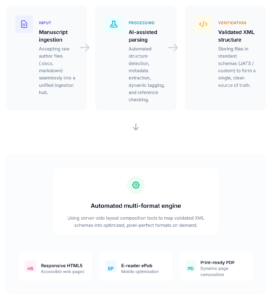
Instead of waiting for the design stage to structure the content, specialized automation engines ingest .docx or Markdown files and apply automated parsing. These tools identify document hierarchies, extract metadata, format equations, and validate citations against global databases (such as Crossref) using automated APIs.
By standardizing content early, publishers establish a single, trusted source of truth. Any editorial correction made to this core XML file automatically cascades across all downstream outputs.
Automating specialized layouts via Quark and InDesign plugin engineering
Automating layout design does not mean sacrificing aesthetic quality. By using server-side automated composition engines, such as Adobe InDesign Server or Quark Publishing Platform, organizations can programmatically generate complex print and PDF layouts directly from structured XML data.
This process is powered by custom plugin engineering and templating:
- Rule-based InDesign templates: Templates are designed with pre-configured paragraph, character, and object styles.
- Automated composition tools: Custom plugins read the incoming XML schema, mapping structural tags (like <chapter-title> or <footnote>) to corresponding layout styles.
- Dynamic copyfitting: Dynamic spacing algorithms automatically adjust line spacing, kerning, and table borders. This ensures that content fits perfectly within designated page layouts without manual design tweaks.
Orchestrating the end-to-end publishing pipeline
Modern editorial operations use workflow orchestration platforms to connect ingestion systems, editorial tools, layout engines, and delivery channels. By replacing manual handoffs with automated API calls, these platforms keep content moving seamlessly through the pipeline.
For example, when an editor approves a manuscript, the orchestration layer automatically converts the file to XML, generates the initial PDF page proofs, and alerts the author for final review. This end-to-end coordination eliminates manual steps, reduces human error, and ensures complete visibility at every stage of the process.
Real-world impact: Accelerating time-to-market at scale
The benefits of migrating to an automated content engineering framework are demonstrated by enterprise leaders who have modernized their publishing infrastructures.
For instance, Pearson, a global publishing organization, successfully reduced manual production bottlenecks through workflow automation. By automating their core production processes, they bypassed traditional layout limitations and significantly accelerated content delivery across multiple channels.
Similarly, in manufacturing and packaging workflows, Manohar Filaments transformed document-heavy operations by implementing intelligent extraction and validation workflows. This transition substantially reduced manual intervention, improved regulatory compliance, and streamlined data handoffs across global operations.
Future-proofing your editorial operations: A strategic roadmap
For publishers looking to eliminate operational friction and transition to an automated content supply chain, the following structured roadmap offers a clear path forward:
- Perform a workflow audit: Map your existing publishing processes. Document where manual file conversions occur, track the frequency of design-editorial round-trips, and identify where files are stored in silos.
- Adopt an XML-first architecture: Move away from PDF-first or Word-centric workflows. Standardize on an XML schema (such as JATS or DocBook) that matches your specific content requirements.
- Invest in API-driven orchestration: Ensure your manuscript submission platforms, editorial tools, and layout engines can communicate via secure APIs. Avoid closed, proprietary systems that prevent automation.
- Leverage specialized layout automation: Work with experienced engineering partners to build custom InDesign or Quark plugins. Automated composition can handle 80% of standard layout formatting, freeing your design team to focus on high-value, creative assets.
- Build a human-in-the-loop framework: Automation is designed to support, not replace, human expertise. Implement intelligent validation steps where editors can quickly review and approve automated conversions.
Conclusion
The traditional, disjointed approach to publishing is no longer sustainable in a digital-first, multi-format market. By replacing manual DTP processes with XML-first workflows, automated layout composition, and unified workflow orchestration, enterprise publishers can eliminate critical bottlenecks and unlock new operational agility.
Organizations exploring publishing automation and content engineering should evaluate whether their existing architecture can support structured XML transformation, automated layout engines, and multi-channel delivery at scale. Partner with Clavis Tech to design and implement robust, future-proof automation solutions that help your publishing business stay ahead of change and drive long-term growth.
FAQ Section
What are the most common publishing workflow bottlenecks?
The most persistent bottlenecks include converting unstructured manuscripts (like Word files) into structured XML, managing slow peer-review and editorial feedback loops, manually styling page layouts in tools like Adobe InDesign, and manually re-tagging content for digital formats like HTML5 and ePub.
How does XML-first publishing help reduce production times?
XML-first publishing structures and validates content at the very start of the process. By creating a single, verified XML file as the source of truth, publishers can automatically generate print-ready PDFs, mobile-responsive HTML5, and ePub files. This eliminates the need for manual, format-specific conversions later in the cycle.
Can automated layout composition handle complex academic or scientific designs?
Yes. By using advanced server-side composition engines (such as Adobe InDesign Server) combined with custom plugin engineering, automated systems can programmatically format complex tables, mathematical equations, footnotes, and multi-column layouts based on predefined XML tags.
What is the difference between workflow automation and workflow orchestration?
Workflow automation focuses on automating single, specific tasks—such as converting a Word document to XML. Workflow orchestration manages, schedules, and coordinates multiple automated tasks and systems across the entire end-to-end publishing pipeline, ensuring seamless data flow between different platforms.
Is legacy modernization required to implement publishing automation?
Not necessarily. While migrating away from highly outdated legacy systems is ideal, modern publishing automation can often be integrated with existing platforms through robust API-driven middleware, custom plugins, and orchestration layers. This allows publishers to modernize their workflows incrementally.
