

For modern publishers and content-heavy enterprises, time-to-publication is no longer just an operational metric. It is a critical driver of market relevance and competitive advantage. In an era where the volume of enterprise content is projected to scale exponentially—reaching a staggering 155 exabytes by 2026—relying on manual, file-centric editorial pipelines is a recipe for operational failure.
According to research from Qvest, 88% of content leaders report that asset demands have at least doubled over the past 24 months, while 85% feel intense pressure to deliver finished content to market faster. Despite these pressures, traditional editorial workflows remain stubbornly bottlenecked by human handoffs, legacy file conversions, and disjointed peer review cycles.
To break this gridlock, forward-thinking organizations are modernizing their content supply chains. By implementing editorial workflow automation, enterprises can replace slow, sequential tasks with parallel, schema-driven, and AI-accelerated workflows. This technical shift reduces time-to-publication by up to 40% while preserving rigorous editorial and compliance standards.
Why legacy publishing pipelines stall
Traditional publishing processes are inherently sequential. A manuscript or enterprise document is written in a word processor, emailed to an editor, manually converted into a PDF, sent to a peer reviewer or legal compliance team, and then returned to the author for revisions.
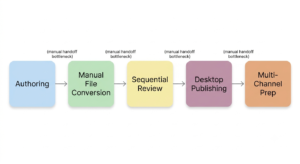 This file-centric methodology introduces three distinct engineering challenges:
- Semantic Silos: Word documents and unstructured PDFs lack native metadata. Editors and production teams must manually tag, catalog, and format content, stalling publication schedules.
- Sequential Bottlenecks: When a document is locked by one reviewer, the entire production pipeline stops. There is no concurrent editing, and version control issues frequently arise.
- Brittle Manual Integrations: Manually transferring text between authoring tools, layout engines (such as Adobe InDesign), and multi-channel delivery platforms creates human error and layout breaks.
These structural inefficiencies can delay publishing schedules from days to months. In highly regulated sectors like pharmaceuticals or scholarly publishing, these delays have real financial impacts. Long queues slow down the release of life-saving medical data or delay time-to-market for compliance-heavy product lines.
The mechanics of modern editorial automation
Resolving these delays requires transforming the underlying content architecture. Modern editorial workflow automation moves away from static documents to structured, semantic, XML-first content pipelines.
In an XML-first workflow, the system ingests raw manuscripts or documents and instantly converts them into structured semantic schemas (such as JATS, DITA, or custom enterprise XML). Once structured, the content is dissociated from its final visual design. This separation of content from presentation allows writing, editing, compliance checking, and layout compilation to run concurrently.
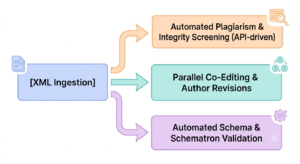
This parallel approach also simplifies editorial integrity checks. Enterprise systems can run real-time, API-driven automated validation checks. Scholarly publishers now deploy tools that automatically verify references, run plagiarism scans (via engines like iThenticate), and use automated image forensics (such as Proofing) to spot manipulated figures.
Comparison: Sequential vs. Automated XML-First Editorial Workflows
| Operational Phase | Legacy Sequential Workflow | Modern Automated XML-First Workflow |
| Ingestion & Format Check | Manual template verification by editorial coordinators. | Instant validation against DTD/Schematron rules. |
| Editorial Review | File lockouts, sequential email distribution. | Simultaneous multi-party co-editing with role-based access. |
| Integrity Screening | Manual citation checking and sampling. | API-driven plagiarism, reference, and graphic forensics [^2]. |
| Composition & Layout | Manual desktop publishing and formatting adjustments. | Automated layout composition using dynamic XML engines. |
| Distribution | Manual exports for web, mobile, print, and syndication. | Multi-channel publishing from a single, structured source. |
How editorial workflow automation slashes time-to-publication
Transitioning to automated workflows yields measurable time savings across the three main bottlenecks of the publishing lifecycle.
1. Automated triage and intelligent reviewer routing
The initial screening of a submission often takes days. Modern automated platforms use intelligent document processing (IDP) and natural language processing (NLP) to read, categorize, and tag incoming files. By evaluating context, the system can automatically flag missing metadata, extract keywords, and assign the best-fit editor or reviewer based on historical matches. High-volume academic journals report nearly 40% faster triage times after automating these initial stages.
2. Live composition and automated layout engines
Manual layout design is often a major bottleneck in the publication chain. Automated composition software connects XML pipelines directly to layout templates in Adobe InDesign or Quark. The system dynamically formats text, positions figures, and generates citations according to pre-defined style sheets. This means documents can be formatted for print, PDF, and digital formats simultaneously, requiring zero manual work from design teams.
3. Workflow automation in action: Real-world proof
Global publishing houses and enterprises are proving the value of this model. For example, Pearson, a major global publisher, eliminated manual bottleneck delays in its production cycles by introducing automated workflows, accelerating content delivery to students and educators.
Similarly, Manohar Filaments modernized its data-heavy, document-centric pipelines by deploying intelligent data extraction and validation workflows. This system automated compliance checks, reduced human intervention, and secured faster operational turnaround times.
Implementing workflow orchestration without breaking the system
Upgrading legacy systems does not require a risky, rip-and-replace approach. Modern publishing architectures use decoupled, microservice-based frameworks. By separating user interfaces, workflow orchestration, and content repositories, companies can modernize their tech stack incrementally.
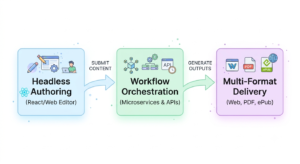
When building automated editorial engines, tech leaders should focus on key technical components:
- Model Context Protocol (MCP) and LLM Orchestration: Advanced platforms utilize MCP and LLM orchestrators to automate metadata tagging and format translation. This lets editorial teams query complex content repositories using natural language prompts [^3].
- Schema Rigor: Standardizing on structured formats like JATS, DITA, or Custom XML ensures content remains portable, future-proof, and easy to translate across delivery channels.
- Security and Audit Trails: Regulated industries require continuous compliance. Automated pipelines can log every change, review, and approval automatically, maintaining a clean audit trail for compliance purposes.
Structuring your automated editorial pipeline for scale
To implement automated workflows successfully, organizations should follow a structured, step-by-step approach:
- Deconstruct the Existing Workflow: Document all manual handoffs, review steps, and file conversions in your current process.
- Establish a Structured Data Model: Adopt XML or JSON-first schemas to standardize your content format.
- Deploy Microservice APIs: Integrate your authoring tool, plagiarism checkers, and design layout software via secure API endpoints.
- Incorporate Human-in-the-Loop Safeguards: Ensure automated tasks (like categorization or layout generation) always have human check-points to verify quality and tone.
- Refine Workflows via Analytics: Track bottlenecks, review cycle times, and automated acceptance rates to continuously optimize the system.
Transforming content bottlenecks into competitive leverage
Editorial workflow automation is no longer just an efficiency upgrade—it is a strategic necessity. By replacing manual, file-based processes with structured, automated workflows, organizations can eliminate bottlenecks, improve compliance, accelerate publishing cycles, and scale content operations with confidence.
Whether you are a scholarly publisher seeking faster peer review or an enterprise managing complex document workflows, automation enables a more agile and resilient content supply chain. Organizations should assess whether their current publishing systems can support modern orchestration, structured data, and parallel workflows to meet evolving business demands.
At Clavis Tech, we help publishers and enterprises modernize legacy systems through XML-first publishing, intelligent document processing (IDP), and workflow automation. If you’re ready to streamline editorial operations and reduce time-to-publication, connect with our experts for a consultation.
FAQs
What is editorial workflow automation?
Editorial workflow automation is the practice of using software, structured schemas (like XML), and smart tools to automate manual tasks in the writing, editing, reviewing, and publishing process. It streamlines file conversions, automatically routes files to reviewers, performs automated integrity checks, and prepares content for multiple distribution channels simultaneously.
How does an XML-first workflow help reduce publishing times?
An XML-first workflow converts raw documents into a structured format right at the ingestion phase. This dissociates content from its visual presentation, allowing editing, proofreading, and layout generation to happen at the same time. This parallel processing cuts out manual formatting steps and reduces layout errors, which significantly accelerates publication times.
Can editorial automation be used in highly regulated industries?
Yes. Modern workflow automation systems are highly effective in regulated fields like healthcare, finance, and legal publishing. These platforms create automatic, tamper-proof logs of every edit, review, and approval. This automated record-keeping ensures compliance, provides reliable audit trails, and minimizes human error.
How do modern editorial systems use AI without losing quality?
Advanced automated workflows use AI to handle routine, time-consuming tasks like keyword tagging, reference formatting, plagiarism scans, and initial file routing. Strategic systems keep human editors in the loop for final decisions on style, context, and quality, ensuring that automation supports rather than replaces human expertise.
Is it necessary to replace our entire legacy CMS to automate our workflow?
No. Modern publishing setups use API-driven microservices. This decoupled approach allows you to connect automated components (such as automated layout tools, XML parsing, and automated routing engines) to your existing content management system (CMS) without needing a risky and costly full system replacement.
