

Traditional publishing models are hitting an operational wall. Media houses, scholarly journals, and corporate publishers are facing unprecedented pressures: the demand for multi-channel content is skyrocketing, yet manual formatting, editing, layout, and schema tagging cycles remain stubbornly slow.
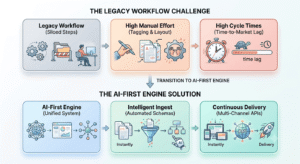
Historically, “automation” meant rigid, rule-based scripts that broke whenever an author changed a font style. Today, integrating AI in publishing workflows means deploying agentic systems capable of semantic understanding, structural conversion, and continuous process optimization.
For enterprise leaders, this is not about replacing editors. It is about migrating from fragmented, legacy content pipelines to highly cohesive, machine-augmented architectures.
The evolution of the content supply chain: From legacy pipelines to AI-first architectures
Modern content operations demand agility. Historically, publishers relied on sequential pipelines: content creation, copyediting, manual XML/HTML tagging, page layout typesetting, and finally, multi-platform distribution. Each transition was a siloed handoff, ripe with human error and time-consuming feedback loops.
Modern content operations demand agility. Historically, publishers relied on sequential pipelines: content creation, copyediting, manual XML/HTML tagging, page layout typesetting, and finally, multi-platform distribution. Each transition was a siloed handoff, ripe with human error and time-consuming feedback loops.
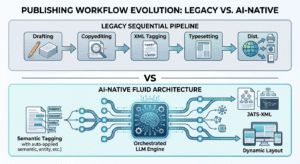
By transitioning to an AI-native content supply chain, the workflow changes from a series of rigid steps into a fluid, parallel architecture. In this paradigm, an orchestrated system ingests unstructured text, extracts metadata, structures semantic elements, and generates multi-channel outputs (print PDFs, EPUB, Web, and mobile feeds) simultaneously.
Industry data underscores this shift. A study by Forrester noted that enterprise pilot counts for multimodal AI in publishing exceeded 200 within a single calendar year, demonstrating that forward-thinking organizations are actively pivoting to AI systems to manage their complex document transformations.[^1] Rather than working with disconnected tools, enterprise editors now act as strategic system managers, overseeing automated workflows that run securely behind private enterprise firewalls.
Where AI drives measurable impact: editorial automation vs. production orchestration
To fully capture the value of automation, publishers must distinguish between editorial automation (which optimizes content quality and structure) and production orchestration (which streamlines layout and asset delivery).
| Workflow segment | Legacy approach | AI-Native transformation | Primary benefit |
| Manuscript ingest | Manual metadata entry, human categorization, slow preliminary review. | LLM-based metadata extraction, automated subject classification, and semantic analysis. | Saves up to 70% of initial ingestion time. |
| Content Transformation | Offshore manual coding of XML, JATS, and HTML5 tags. | Agentic orchestration mapping unstructured text directly to schemas. | Instant schema compliance; error-free structures. |
| Typesetting & layout | Visual designers manually placing elements in InDesign or Quark. | API-driven specialized layout engine executing dynamic templates. | Near-real-time digital and print proofing. |
Intelligent manuscript ingest, taxonomy tagging, and automated peer review routing
The journey of any manuscript or comprehensive report begins with ingestion. Manual indexing, keyword tagging, and taxonomic classification consume valuable hours that senior editors should spend on content curation and strategy.
AI-driven agents solve this by performing real-time structural analysis of incoming documents. By processing manuscripts through customized Large Language Models (LLMs) configured with specialized industry taxonomies, systems can:
- Automatically extract primary metadata (author affiliations, funding sources, abstract entities, and citations).
- Tag content with highly accurate taxonomies, boosting search engine discoverability (SEO) and internal content reuse.
- Match and route articles to peer reviewers by cross-referencing manuscript themes with database-driven reviewer profiles and past publications.
Smart content transformation: XML-first publishing and JATS conversion engines
For scientific, technical, and medical (STM) publishers, structured XML—especially the Journal Article Tag Suite (JATS) standard—is the lifeblood of content syndication. Translating raw Word files or PDFs into compliant JATS XML has traditionally been outsourced to manual, costly vendors, delaying time-to-market.
Clavis Tech approaches this challenge with smart content transformation & delivery systems. Our specialized parsing engines use fine-tuned, localized LLMs combined with traditional regex boundary guards to parse unstructured text. The model identifies structural components (headers, footnotes, equations, tables, and bibliographies) and converts them into pristine JATS XML instantly.
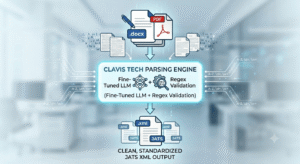
This ensures that the output is highly accurate, conforms fully to the requested DTD (Document Type Definition), and passes structural validation tests before hitting downstream repositories.
Specialized layout automation: dynamically bridging CMS to InDesign and Quark APIs
The formatting process has long been a notorious bottleneck in editorial production. Manual typesetting in Adobe InDesign or QuarkXPress creates a disconnect between the master text stored in the CMS and the final visual layouts.
Modern specialized layout & design automation bridges this gap using API-driven plugin engineering. By executing headless InDesign Server or Quark APIs directly from the central workflow orchestrator, the system dynamically populates predefined templates with structured content. For example, Pearson, a global leader in education and publishing, developed a custom QuarkXPress XTension to automate catalog production, transforming Excel-based content into print-ready layouts while eliminating manual formatting and data-entry errors.
This means a modification made by an editor in the CMS is immediately updated in the print-ready PDF and digital layouts. It eliminates version-control issues and allows publishers to scale output volumes without linearly growing design and production budgets.
Enterprise AI implementation considerations: quality, compliance, and IP protection
Deploying AI within enterprise publishing is more than just API integration; it requires strict adherence to legal, ethical, and quality frameworks. Because your content is your intellectual property, using public AI tools presents significant risks.
When designing AI-first publishing workflows, engineering teams must address three main concerns:
- Data Sovereignty: Enterprise systems should process sensitive manuscripts inside isolated cloud environments (such as AWS VPCs or Azure Private Link). This ensures your training data is never exposed to public LLMs.
- Contextual Accuracy (RAG): To eliminate AI hallucinations, systems use Retrieval-Augmented Generation (RAG). By grounding LLMs in verified corporate styling guides, past publications, and terminology databases, outputs remain accurate and on-brand.
- Traceability and Audit Logs: Every automated action—whether it is copyediting, metadata generation, or schema conversion—must be logged. This leaves a clear audit trail for human editors to review and approve.
Conclusion
The future of publishing is structured, intelligent, and highly automated. Organizations that continue to rely on manual document formatting, siloed editorial pipelines, and outdated CMS platforms will struggle to keep pace with an increasingly agile market. Integrating AI in publishing workflows is not simply a trend; it is the foundation of modern media operations.
Organizations exploring publishing automation and AI-first product engineering should evaluate whether their existing architecture can support advanced orchestration, structured metadata extraction, and agentic workflows at scale.
Are you ready to modernize your legacy platforms and eliminate manual production bottlenecks? Explore how Clavis Tech’s publishing automation & content engineering services can transform your operational efficiency and accelerate your content delivery.
FAQ
How does AI improve scientific and scholarly publishing workflows?
AI speeds up scientific publishing by automating manuscript ingestion, extracting metadata, and performing initial quality and plagiarism checks. It can also match manuscripts with suitable peer reviewers, reducing administrative bottlenecks and accelerating publication times.
What is XML-first publishing and why is it important?
XML-first publishing is an editorial approach where raw text is converted into structured XML (such as JATS) early in the production cycle. This allows publishers to simultaneously output print PDFs, responsive web pages, and mobile formats from a single source file, bypassing manual, multi-format formatting.
Can legacy CMS platforms support modern AI tools?
Yes. Instead of doing a risky, high-cost system replacement, publishers can wrap legacy CMS platforms in a microservices layer. This allows modern AI engines and LLMs to interact with old databases via secure APIs, enabling advanced automation without disrupting daily operations.
How does Clavis Tech handle IP protection in AI workflows?
Clavis Tech designs enterprise AI systems with strict data security protocols. By deploying models within isolated VPCs (Virtual Private Clouds) and using private APIs, your proprietary content and manuscripts are never exposed to public training sets or external third parties.
What role does Adobe InDesign automation play in modern publishing?
Adobe InDesign automation uses API integrations and custom plugins to automatically populate print templates with structured content directly from a CMS. This eliminates manual typesetting, ensures consistent design standards, and speeds up page composition.
Footnotes
[^1]: Forrester Research: The Multimodal AI Ecosystem in Creative Writing and Publishing Segments (Q4 2024). Forrester
