

Enterprise organizations face an unprecedented content crisis. According to PwC’s Global Entertainment & Media outlook, the sheer volume of multi-channel publishing demands has turned content supply chains into operational bottlenecks [^1]. Traditional, manual editorial workflows can no longer scale to meet multi-format, multi-platform, and highly personalized distribution requirements.
However, the solution is not a complete, unchecked replacement of human editors with generative AI. Instead, the highest operational value is unlocked by systematically identifying where editorial workflow automation acts as a force multiplier, and where human editorial judgment remains non-negotiable.
This guide maps the economic and technical realities of automated vs. manual publishing pipelines, providing a blueprint for modern content engineering.
Why manual editorial processes fail the modern enterprise
Manual editorial workflows are plagued by friction. In a legacy pipeline, highly skilled editors spend up to 40% of their billable hours on non-cognitive, administrative tasks: formatting files, structured XML schema tagging, copy-pasting across Content Management Systems (CMS), and manually validating compliance guidelines.
This misallocation of human capital leads to:
- Severe time-to-market delays: It takes days, sometimes weeks, to move a complex technical document, scientific journal, or localized marketing campaign from draft to distribution.
- Siloed content delivery: Manual composition requires separate teams to layout PDFs, code HTML, and format mobile app feeds, leading to redundant work.
- Compounded technical debt: Without automated schemas, legacy data sits in unstructured, non-reusable formats (like flat Word documents or PDFs) that are incompatible with modern digital ecosystems.
Consider how Pearson, a giant publishing organization, faced similar pressures. By executing a tailored approach to publishing automation, they successfully reduced manual production bottlenecks through robust workflow automation, enabling significantly faster content delivery across their global catalog.
The taxonomy of editorial tasks: where AI wins vs where humans excel
To build a high-yield hybrid publishing model, enterprise leaders must categorize editorial tasks based on cognitive complexity and structural repeatability.
| Editorial phase | Core tasks | Optimal execution model | Primary value metric |
| Ingestion & prep | Format normalization, basic extraction, XML schema validation | 100% Automated | 90% reduction in setup time |
| Stylistic editing | Grammar, style guide adherence, structural flow, syntax corrections | Hybrid (AI assisted) | 50% faster turnaround |
| Semantic tagging | Metadata generation, taxonomy mapping, entity extraction, SEO schema | 95% Automated | Absolute consistency at scale |
| Layout & composition | Multi-channel rendering, print-to-digital reflow, responsive design | Automated (XML-first) | Elimination of pixel-pushing |
| Creative direction | Tone alignment, investigative verification, strategic narrative, branding | 100% Human | Brand safety and intellectual depth |
Mapping automation value across the content supply chain
True publishing transformation occurs when automated pipelines handle the mechanical heavy lifting, allowing human creators to focus exclusively on content quality and strategic direction.
Intelligent document processing and structured content conversion
Unstructured data is the silent killer of editorial velocity. When authors submit manuscripts or source files in varying formats, manual cleanup is costly. Modern publishing automation leverages Intelligent Document Processing (IDP) to automatically ingest, parse, and convert flat files into semantically enriched, structured XML or JSON.
For instance, Manohar Filaments transformed document-heavy operations by implementing intelligent extraction and validation workflows, reducing manual intervention and improving compliance across their extensive logistics and product documentation pipelines.

Automated layout generation and multi-channel delivery
Desktop publishing (DTP) has traditionally been an expensive, manual bottleneck. Designers spend hours manually reflowing text inside tools like Adobe InDesign or QuarkXPress to fit mobile, web, and print parameters.
By utilizing XML-first publishing engines, Clavis Tech automates the composition process. Content is stored independently of its layout. When published, advanced template engines programmatically generate high-fidelity PDFs, print-ready layouts, and digital responsive web pages simultaneously, shrinking layout times from weeks to minutes.
Context-aware semantic tagging and metadata enrichment
Manual tagging is notoriously inconsistent; two editors will often tag the exact same article with different keywords. AI-driven semantic tagging analyzes content in real time to apply highly accurate, standardized taxonomies. This enhances discoverability, optimizes search engine indexing, and fuels personalized content recommendations.
How agentic workflows redefine publishing operations
We are moving past static template automation into the era of agentic workflows. As highlighted in McKinsey’s Technology Trends Outlook, generative AI is shifting from passive drafting tools to autonomous “virtual coworkers” capable of orchestrating multi-step operational chains [^2].
In an agentic publishing model, an AI agent orchestrator manages the entire lifecycle of a piece of content:
- The ingestion agent detects a new manuscript, runs an automated plagiarism and style compliance check, and converts it to XML.
- The translation & localization agent automatically drafts accurate, localized versions in five target languages while preserving specialized terminology.
- The metadata agent extracts key entities, assigns taxonomies, generates SEO meta-descriptions, and schedules social media distribution.
- The Human-in-the-Loop (HITL) gatekeeper reviews the final unified dashboard to approve, tweak, or reject the automatically compiled package.
This paradigm is highly practical. Spirra by Refuel agency built an AI-driven automation initiative to enable near real-time content generation while maintaining strict quality controls. By establishing clear guardrails, they unlocked speed without risking brand reputation.
Strategic implementation: transitioning to a hybrid editorial model
Migrating from legacy manual processes to an automated content supply chain requires a structured, phase-based engineering approach.
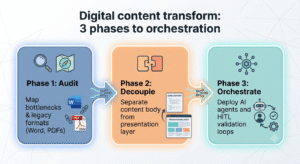
- Conduct a content supply chain audit: Identify where your editors spend the most time performing non-creative, repetitive tasks.
- Decouple content from presentation: Transition to an XML-first or headless CMS architecture. Storing your content in a clean, structured format is a prerequisite for AI and automation engines to read and transform it.
- Integrate modular AI services: Rather than deploying a single, massive monolithic system, integrate specialized microservices (e.g., an API for document intelligence, another for automated layout rendering).
- Establish rigorous human-in-the-loop (HITL) control points: Designate clear stages where human editors must validate AI-generated tagging, translations, or layouts to ensure absolute quality control.
The business impact: quantifying the ROI of publishing automation
Enterprise leaders must justify technology investments with clear, measurable business returns. Recent longitudinal data from Deloitte indicates that organizations dedicating a strategic portion of their digital budgets to AI automation achieve far higher ROI and enterprise value [^3].
In creative and publishing departments, those returns manifest as:
- 60% reduction in production cycle times: Shortening content generation, editorial review, and formatting processes.
- Lower overhead costs: Minimizing outsourced DTP, typesetting, and manual indexing agencies.
- Omnichannel agility: Enabling brands to launch new publishing formats (e.g., audio, interactive web, print) almost instantly without expanding headcount.
- Minimized compliance risks: Automated checks flag copyright infringements, non-compliant phrasing, or formatting errors before they reach public channels.
Balancing innovation with editorial compliance
While the velocity gains of automated workflows are undeniable, enterprise-grade publishing requires absolute compliance, particularly in scholarly, medical, or corporate communications. Generative AI alone can hallucinate, making unchecked automation a liability.
To mitigate this, Clavis Tech deploys hybrid architectures that combine Retrieval-Augmented Generation (RAG) with deterministic rules. By restricting AI engines to verified internal repositories and enforcing strict validation guardrails, organizations can benefit from generative speed while remaining 100% compliant with editorial standards.
Conclusion
The debate is no longer about “AI vs. Humans” in the newsroom or publishing house. The future belongs to hybrid, orchestrated content supply chains. By automating the highly repetitive, structural, and format-intensive tasks of publishing, organizations free their editorial talent to do what they do best: create compelling, impactful stories.
Organizations exploring AI-first product engineering or legacy publishing modernization should evaluate whether their existing architecture can support automation, memory, and agent-driven workflows at scale.
Ready to transform your content supply chain? Contact Clavis Tech today to discover how our Publishing Automation and Smart Content Transformation services can modernize your editorial workflows.
FAQs
What is editorial workflow automation?
Editorial workflow automation is the process of using software, artificial intelligence, and predefined rules to streamline and execute repetitive publishing tasks—such as document ingestion, format conversion, metadata tagging, compliance checks, and multi-channel layout rendering—without requiring manual human intervention.
How does AI improve publishing operations?
AI improves publishing operations by eliminating mechanical bottlenecks. It automates unstructured data extraction, translates content instantly, generates structured XML metadata, and auto-composes layouts for different devices. This reduces production cycles by up to 60% while allowing editors to focus on creative quality.
What is the role of human-in-the-loop (HITL) in AI publishing?
Human-in-the-loop (HITL) is a design pattern where human editors review, refine, and approve AI-generated outputs at critical stages of the editorial pipeline. This ensures absolute brand safety, accuracy, compliance, and stylistic consistency, mitigating any risks of AI hallucinations.
What is XML-first publishing?
XML-first publishing is an architecture where content is created and stored in a neutral, structured XML format independent of its visual styling. This allows automation engines to dynamically render the same content across print, web, PDF, and mobile channels without manual redesign.
Can AI completely replace human editors?
No. AI cannot replicate human judgment, nuanced storytelling, investigative depth, or emotional resonance. The most successful modern publishers use a hybrid approach where AI orchestrates repetitive operational workflows while human editors retain full creative control.
Footnotes
[^1]: Global Entertainment & Media Outlook 2024-2028, PwC, October 2024. PwC Media Outlook
[^2]: Technology Trends Outlook 2025, McKinsey & Company, July 2025. McKinsey Tech Trends
[^3]: AI and Tech Investment ROI: 2025 Tech Value Survey, Deloitte Insights, October 16, 2025. Deloitte Tech Value
